
Curing plays a direct role in the carbon footprint of concrete. The conditions under which concrete hardens determine how much cement is needed, how quickly strength develops, and whether additional carbon dioxide can be mineralised permanently into the product structure. For precast concrete producers, curing is not just a production step: it is a lever for controlling both material performance and environmental impact. The sections below address the most common questions about curing, carbon dioxide, and concrete performance.
How does the curing process affect concrete’s carbon footprint?
The curing process affects concrete’s carbon footprint primarily by determining how much cement the mix requires to reach the necessary strength. Cement production is one of the most carbon-intensive steps in concrete manufacturing, so any reduction in cement content directly reduces the carbon footprint of the finished product. Curing conditions that accelerate strength development allow producers to use less cement without compromising performance.
In conventional curing, concrete is typically kept at a controlled temperature and humidity until it reaches sufficient strength. This process is calibrated around the cement content needed to meet early-age strength requirements. When those requirements are high, cement content goes up, and so do emissions from raw material production.
Carbon dioxide curing changes this relationship. By introducing CO₂ into the curing chamber during the early hardening phase, the process accelerates strength development through mineralisation reactions. This means the mix can achieve the required strength with less cement. The result is a lower carbon footprint from raw materials, combined with additional emission reductions from the CO₂ that is permanently stored in the concrete during curing.
What happens to CO₂ when it is used to cure concrete?
When CO₂ is introduced into a curing chamber during the early hardening phase, it reacts with calcium ions present in the cement and supplementary cementitious materials to form calcium carbonate minerals. This process, known as CO₂ mineralisation, converts gaseous carbon dioxide into a solid carbonate that becomes part of the concrete’s structure. The CO₂ does not escape: it is chemically bound and permanently stored.
The mineralisation process takes place in two stages. In the first stage, during the initial hours of curing, CO₂ reacts with calcium from the cement to produce ultrafine calcium carbonate particles. These particles act as nucleation sites, providing surfaces on which further hydration products can form. This accelerates the early strength development of the concrete.
In the second stage, which unfolds over the following days and weeks, the presence of calcium carbonate drives further reactions. Free silica forms and reacts with remaining cement hydration products through a pozzolanic reaction, contributing additional strength gain. This two-stage process explains why CO₂-cured concrete often continues to develop strength beyond the initial curing period.
The mineralisation also densifies the microstructure of the concrete. Carbonates occupy a larger molar volume than the hydrate phases they replace, which fills pore spaces and reduces permeability. This has practical consequences for durability and leaching behaviour, as the denser structure is less soluble in contact with water.
Does CO₂ curing actually make concrete stronger?
Yes, CO₂ curing strengthens concrete through several distinct mechanisms that act on its microstructure. The mineralisation process densifies the concrete by replacing hydroxide phases with carbonates, which occupy more volume and reduce porosity. This leads to measurable improvements in compressive strength and mechanical stability compared to conventionally cured concrete of the same mix design.
The strength improvements come from at least three mechanisms acting in combination. First, the replacement of hydroxides with carbonates reduces pore volume and increases density. Second, the release of water during carbonation reactions provides additional moisture for continued cement hydration. Third, the pozzolanic reactions triggered by free silica formation contribute further strength development in the days and weeks after the initial curing period.
An important practical implication is that these strength gains allow producers to reduce cement content while maintaining the same performance standard. The goal is not to produce concrete that exceeds specification, but to reach the same performance level with a leaner mix. This is the basis for cement savings in carbon dioxide curing: the concrete reaches the required strength with less cement, not by becoming stronger than necessary.
CO₂ curing also reduces the tendency for calcium-based efflorescence to form on the surface of concrete products. The early formation of calcium carbonate during curing consumes the portlandite that would otherwise migrate to the surface, improving the visual quality and long-term stability of the product.
What types of concrete products benefit most from CO₂ curing?
Precast concrete products cured in enclosed chambers benefit most from CO₂ curing. The process requires a controlled environment where CO₂ concentration can be managed during the early hardening phase, which makes it well suited to factory production with dedicated curing chambers. Products such as wall elements, pavement slabs, blocks, and other precast infrastructure components are the primary candidates.
Products that rely on early-age strength for demoulding and handling are particularly well matched to carbon dioxide curing. In conventional production, these products often require elevated cement content to achieve the necessary early strength. CO₂ curing accelerates early strength development, which means the mix can be leaner without delaying production cycles.
Lightweight concrete elements also respond well to CO₂ curing. These products typically have lower packing strength and depend on excess cement for early-age performance. The accelerating effect of CO₂ mineralisation addresses this need without the cement penalty, making it possible to incorporate a higher proportion of supplementary cementitious materials or alternative binders.
Products that use slag or other calcium-rich industrial byproducts as part of the binder system benefit additionally, because CO₂ can activate materials that are otherwise passive in conventional curing. Certain slag types that do not contribute meaningfully to strength in normal conditions become reactive in the presence of CO₂, opening up new material combinations that reduce cement content further.
Can CO₂-cured concrete achieve a carbon-negative footprint?
CO₂-cured concrete can achieve a carbon-negative footprint when the right combination of material mix and process conditions is used. This requires both a significant reduction in cement content and a sufficient volume of CO₂ permanently mineralised into the product. When industrial byproducts such as steel slag replace a large proportion of the cement, and CO₂ mineralisation stores additional carbon in the structure, the total carbon balance of the product can move into negative territory.
The carbon footprint of concrete is calculated by accounting for emissions from raw materials, production energy, and transport, then subtracting any CO₂ that is permanently stored in the product. In conventional concrete production, the emissions from Portland cement dominate this calculation. Replacing cement with lower-emission alternatives reduces the positive side of the balance, while mineralised CO₂ adds a negative contribution.
The combination of these two effects is what makes a carbon-negative result possible. Neither cement reduction alone nor CO₂ storage alone is typically sufficient to reach a negative footprint. Together, and with the right material inputs, they can shift the balance. The mix design and the amount of CO₂ introduced during curing both need to be optimised for the specific product and production context.
It is worth noting that not every product or production facility will achieve a carbon-negative outcome. The result depends on the cement type used, the availability and composition of supplementary materials, the CO₂ source, and the baseline emissions of the facility. Carbon dioxide curing consistently reduces the carbon footprint of concrete, but the degree of reduction varies with these factors.
How is the carbon stored in cured concrete verified and measured?
Carbon stored in CO₂-cured concrete is measured through gas flux monitoring in the curing chamber, which tracks the difference between CO₂ introduced and CO₂ remaining after the curing cycle. The amount of CO₂ that has been absorbed by the concrete is calculated from this measurement. Laboratory-tested control samples are used to confirm the accuracy of the process data and validate the mineralisation results.
Verification requires that the measurement process meets recognised standards for carbon dioxide removal (CDR) credits. This includes demonstrating additionality, meaning the CO₂ storage would not have occurred without the specific process, and permanence, meaning the mineralised CO₂ will remain stored for a period that meets market and regulatory requirements. Carbonate minerals formed during CO₂ curing are considered permanently stable, remaining bound in the concrete structure even if the product is eventually demolished and recycled.
Independent certification by a third-party body is the standard approach for converting measured CO₂ storage into verified carbon credits. The certification process checks the methodology, the measurement data, and the documentation chain. Carbonaide’s process is certified under Isometric’s module for CO₂ storage via carbonation in the built environment, which provides an independently verified framework for quantifying and certifying durable CDR credits.
The Carbonaide Service Platform manages this data chain in practice. It records CO₂ flow measurements in real time, generates the documentation required for carbon credit certification, and supports reporting at the product and batch level. This means concrete producers using carbon dioxide curing have access to the data they need for environmental product declarations, carbon credit applications, and compliance reporting without requiring a separate data management system.
How Carbonaide supports low-carbon concrete production through CO₂ curing
Carbonaide provides a complete system for introducing carbon dioxide curing into precast concrete production. The solution is designed to work within existing factory environments, either by integrating with new curing chambers or by retrofitting existing ones, so producers do not need to rebuild their facilities to adopt the technology.
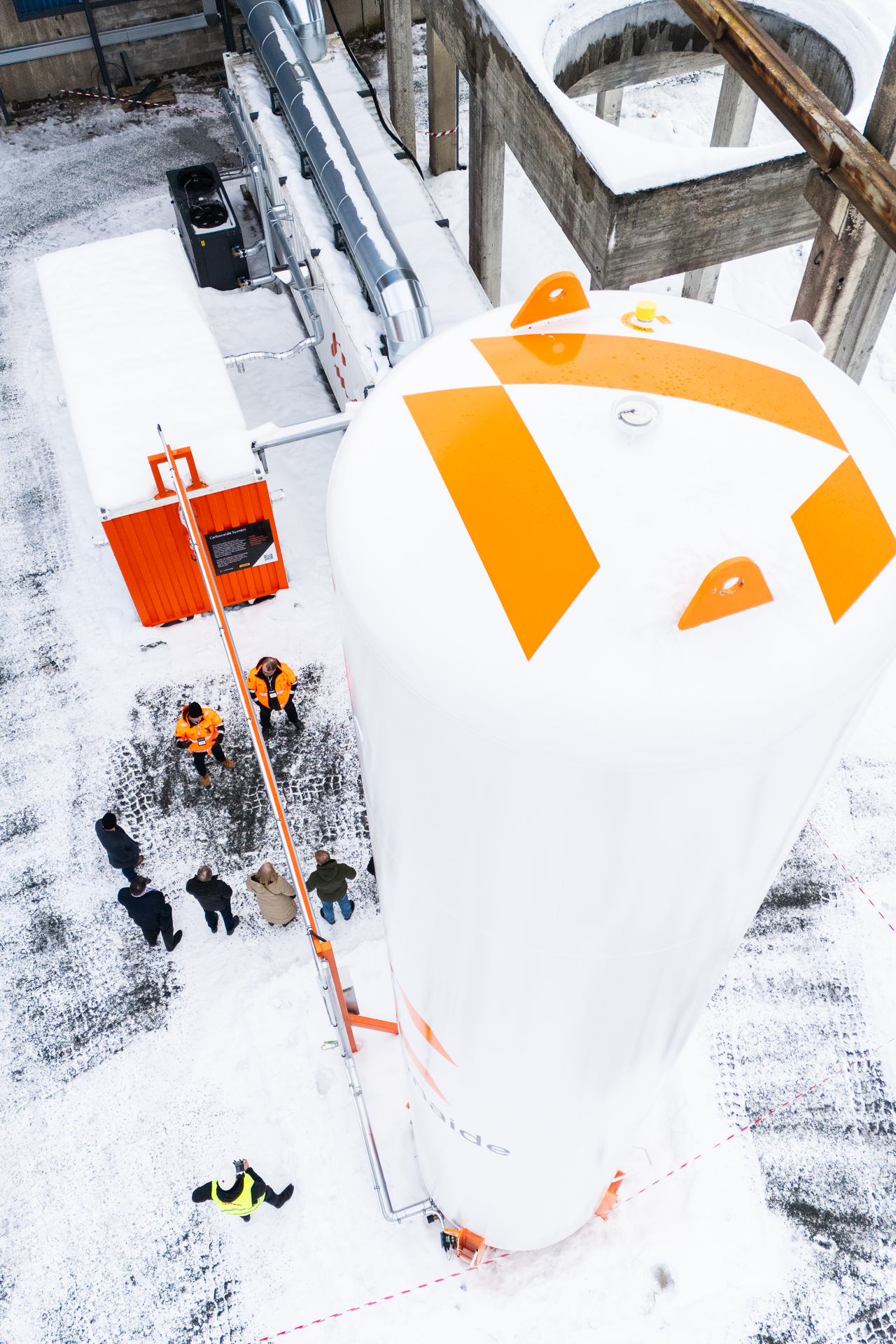
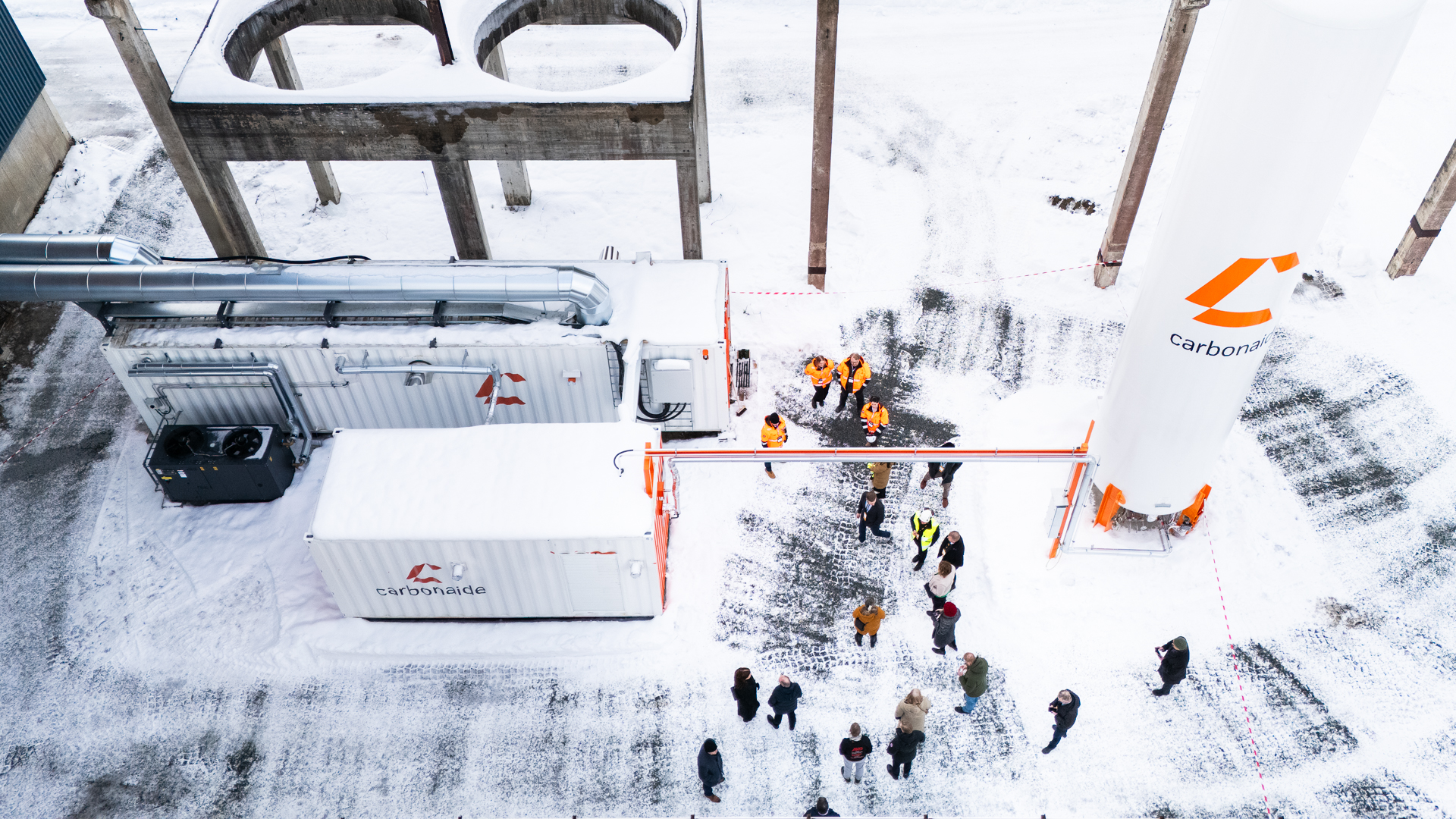
- Carbonaide CO₂ Curing System: Hardware for managing CO₂ flow in curing chambers, including the process module, CO₂ supply integration, and chamber modifications. The system operates at atmospheric pressure and is compatible with a wide range of precast product types.
- Carbonaide Service Platform: Cloud-based software that manages CO₂ flow, records mineralisation data, and generates documentation for carbon credit verification and environmental reporting. The platform supports compliance with carbon market regulations and integrates with factory management systems where needed.
- Carbonaide Care: Lifecycle support covering project planning, system setup, maintenance, and calibration. Two service packages are available depending on the level of support required.
The practical outcome for precast producers is a reduction in cement content, shorter curing cycles, and a measurable reduction in the carbon footprint of their products. For producers working with slag or other industrial byproducts, the combination of CO₂ curing and alternative binder systems can shift the carbon balance of specific products into negative territory. The full Carbonaide solution addresses both the production and the documentation side of low-carbon concrete manufacturing in a single integrated system.