
Concrete manufacturers can demonstrate permanent carbon storage to customers through a combination of process-level measurement, independent third-party verification, and certified carbon documentation. The key is that CO₂ mineralization produces a chemically stable end state: carbon dioxide is converted into carbonate minerals within the concrete structure, making the storage physically verifiable rather than a matter of estimation or assumption. The sections below address the most common questions manufacturers face when building a credible carbon storage case for customers, buyers, and sustainability teams.
What methods exist for verifying permanent carbon storage in concrete?
Permanent carbon storage in concrete is verified through gas flux measurement during the curing process, combined with laboratory analysis of control samples. The CO₂ entering the curing chamber and the CO₂ leaving it are both measured continuously, and the difference represents the amount mineralized into the concrete. Laboratory-tested samples confirm that the software calculations reflect what actually happened in the material.
This dual approach, process measurement combined with physical sample analysis, gives verification a level of rigor that distinguishes it from estimated or modeled carbon claims. The measurement happens at the point of production, which means the data is tied directly to specific product batches rather than averaged across a facility or a product category.
Independent certification adds a further layer of credibility. Third-party verifiers review the measurement methodology, the data collected, and the documentation chain before issuing certified carbon removal credits. This process mirrors the verification logic used in other carbon markets, where additionality, permanence, and quantification must all be demonstrated before a credit is issued.
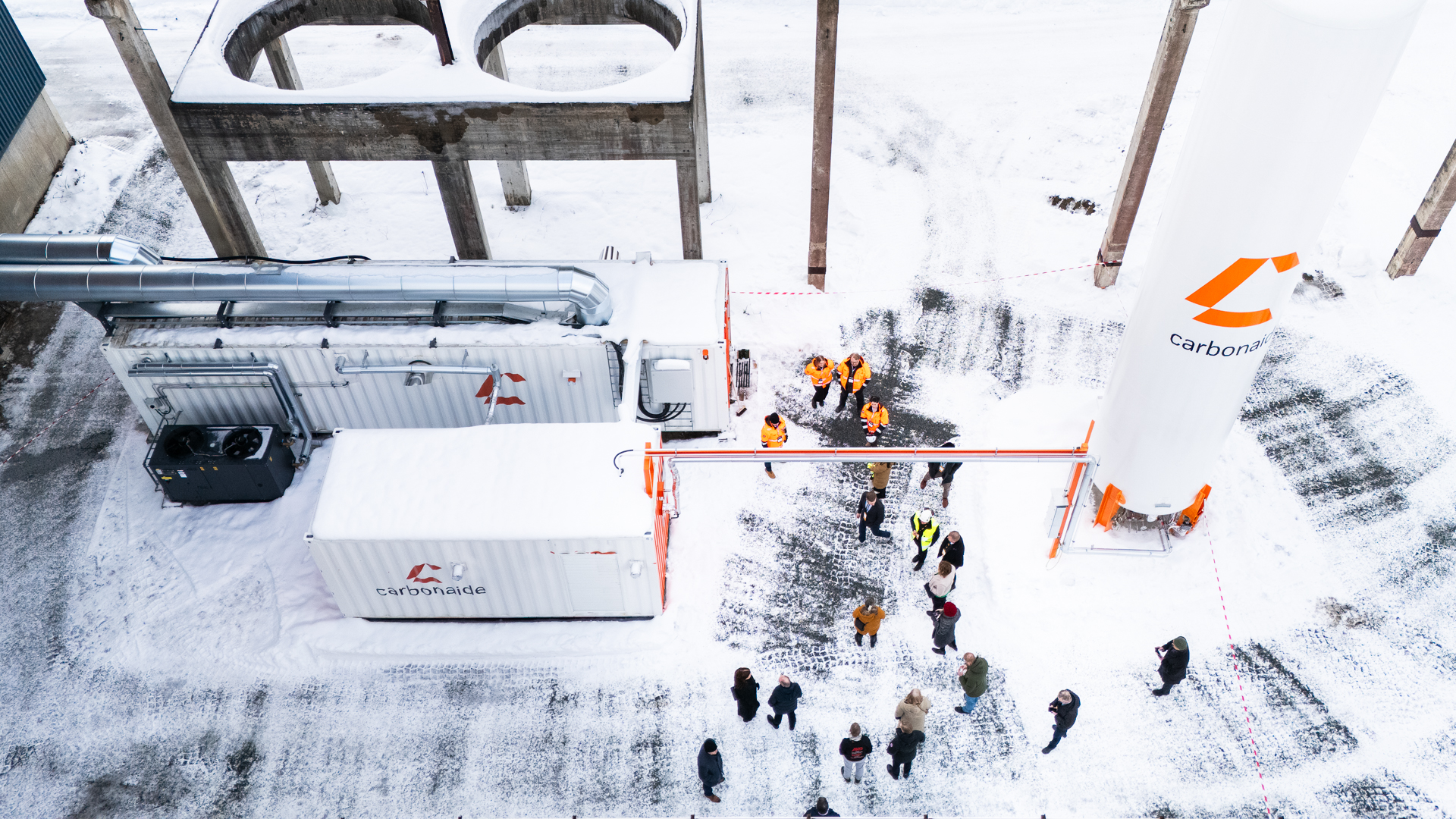
For precast concrete manufacturers, verification is most straightforward when the curing process takes place in controlled, gas-tight chambers. These conditions allow precise measurement of CO₂ flows and minimize the variables that would otherwise complicate quantification.
How does CO₂ mineralization differ from other carbon storage approaches?
CO₂ mineralization in concrete converts carbon dioxide into solid carbonate minerals within the concrete matrix. This is a permanent chemical transformation: the CO₂ is no longer a gas and cannot be released back into the atmosphere, even if the concrete product is later demolished or recycled. This makes mineralization fundamentally different from approaches where carbon is stored in biological systems or geological formations that carry reversal risk.
Approaches such as reforestation or soil carbon sequestration store carbon in forms that can be released again through fire, decomposition, or land-use change. Geological storage in underground formations is more stable but requires ongoing monitoring and carries long-term liability questions. CO₂ mineralization in concrete avoids both of these complications because the storage mechanism is a chemical reaction, not physical containment.
Another distinction is that CO₂ mineralization in precast concrete production happens as part of the manufacturing process itself. The carbon storage is not a separate, additional step added to an existing process. The CO₂ introduced during curing reacts with calcium ions from the cement binder, forming calcium carbonate minerals that become part of the concrete’s microstructure. This integration means that storage verification is tied directly to production records rather than requiring separate monitoring infrastructure.
When industrial byproducts such as steel slag are used as alternative binders alongside CO₂ curing, the combined effect can push the calculated carbon footprint of the concrete product into negative territory. This is because the mineralized CO₂ represents a removal from the atmosphere, while the reduced reliance on Portland cement lowers the emissions associated with raw material production.
What carbon footprint data can concrete manufacturers share with customers?
Concrete manufacturers using CO₂ mineralization can provide customers with product-level carbon footprint data that includes both the emission reductions from reduced cement content and the negative emissions from mineralized CO₂. This data can be reported by product type and by production batch, giving customers the specificity they need for their own environmental reporting and procurement decisions.
The most recognized format for sharing this data with building industry customers is the Environmental Product Declaration, or EPD. An EPD is a standardized, third-party verified document that reports the environmental impact of a product across its life cycle. For concrete products, the EPD includes the global warming potential expressed in kilograms of CO₂ equivalent per cubic meter or per unit of product. When CO₂ mineralization is part of the production process, the mineralized carbon is included in this calculation, which can result in a significantly lower, or even negative, carbon footprint figure compared to conventionally produced concrete.
Beyond EPDs, manufacturers can share batch-level carbon storage reports generated from process measurement data. These reports document the amount of CO₂ mineralized per cubic meter of concrete for specific production runs. This level of detail is increasingly requested by construction companies and developers who need to account for embodied carbon in their building projects and report against targets such as those set under whole-life carbon assessment frameworks.
The Carbonaide Service Platform supports this reporting process by centralizing carbon data management, generating documentation by product type and batch, and connecting process measurements to certification workflows. This reduces the administrative burden on manufacturers while producing the structured data that customers and auditors expect.
Which standards and frameworks apply to carbon credits from concrete production?
Carbon credits from CO₂ mineralization in concrete fall under the category of carbon dioxide removal, or CDR, credits. These are distinct from carbon offset credits, which typically represent avoided emissions rather than actual removal. The standards and frameworks that apply depend on whether the credits are used internally for carbon accounting or sold on voluntary carbon markets.
For voluntary carbon market transactions, the relevant requirement is certification under a recognized CDR methodology. Carbonaide’s process is certified under Isometric’s module for CO₂ storage via carbonation in the built environment. Isometric applies rigorous criteria for additionality, permanence, and quantification, which are the three pillars that any credible carbon removal claim must satisfy.
Additionality means that the carbon storage would not have occurred without the specific activity and its associated revenues. CO₂ mineralization in concrete production meets this criterion because the process is not required by regulation and would not be economically viable without CDR credit revenues in most production contexts.
Permanence means that the stored carbon will remain stored. Carbonate minerals formed during the mineralization process are stable over timescales exceeding one thousand years and are not released even if the concrete is crushed and recycled. This is a stronger permanence claim than most biological carbon storage methods can make.
Quantification means that the amount of carbon stored can be measured accurately and independently confirmed. Gas flux measurement combined with laboratory sample analysis satisfies this requirement when the data is reviewed by an independent verifier before credits are issued.
For carbon accounting within building projects, the relevant frameworks include life cycle assessment standards and embodied carbon reporting protocols used by architects, developers, and certifying bodies. EPDs produced under recognized product category rules are the standard vehicle for communicating concrete carbon footprint data within these frameworks.
How can manufacturers communicate carbon storage claims without greenwashing risks?
Manufacturers can communicate carbon storage claims credibly by grounding every claim in measured data, third-party verification, and recognized certification. The risk of greenwashing arises when claims are vague, unverifiable, or overstated relative to what the evidence supports. Precise, documented, and independently verified claims do not carry this risk because they can be examined and confirmed by any party.
Several practical principles reduce greenwashing risk in this context:
- Distinguish between emission reductions and carbon removal. Reduced cement content lowers the emissions associated with production. Mineralized CO₂ represents actual carbon removal. These are different things and should be reported separately rather than combined into a single undifferentiated claim.
- Tie claims to specific products and batches. General statements about a facility’s environmental performance are harder to verify and easier to challenge. Batch-level data linked to specific production records is more defensible.
- Reference the certification standard. Stating that carbon storage has been certified under a named standard, such as Isometric’s carbonation module, gives customers and auditors a reference point they can check independently.
- Use EPDs as the primary customer-facing document. EPDs are produced under standardized rules, verified by accredited third parties, and recognized across the building industry. They provide a structured and comparable format that customers understand.
- Avoid claims about permanence that go beyond what the science supports. Carbonate mineralization is genuinely permanent, but this claim should be accompanied by a brief explanation of the chemistry rather than stated as a marketing assertion without context.
Concrete manufacturers that invest in process-level measurement infrastructure and third-party certification from the start are in a much stronger position than those who attempt to make carbon claims based on estimated or modeled data. The verification chain, from gas flux measurement through laboratory confirmation to independent certification, is what separates a credible carbon storage claim from an unsubstantiated one.
Communicating these claims to customers also benefits from clarity about what the numbers represent. A carbon footprint figure expressed in kilograms of CO₂ equivalent per cubic meter, supported by a verified EPD and a certified CDR credit document, gives building companies the specific, auditable information they need to include the product in their own environmental reporting with confidence.
How Carbonaide supports carbon storage verification and communication
Carbonaide provides concrete manufacturers with the tools and documentation needed to demonstrate permanent carbon storage to customers, auditors, and carbon market buyers. The solution covers the full verification chain:
- Process-level measurement: The Carbonaide CO₂ Curing System measures CO₂ flows with industry-leading precision, generating the raw data that underpins all carbon storage claims.
- Software-based data management: The Carbonaide Service Platform centralizes carbon data by product type and batch, supports EPD calculations, and manages documentation for carbon credit certification.
- Third-party certification: Carbonaide’s process is certified under Isometric’s module for CO₂ storage via carbonation in the built environment, providing manufacturers with independently verified CDR credits.
- Carbon credit management: Manufacturers can either count the stored carbon as a reduction in their product carbon footprint or sell verified CDR credits on voluntary carbon markets through Carbonaide’s partner network.
The result is a documented, verifiable, and certifiable carbon storage claim that manufacturers can share with customers without greenwashing risk, backed by measured data and recognized third-party standards.