

Part 1: Capture, Utilize and Store
From our planet’s point of view, carbon dioxide is carbon dioxide, regardless of where it came from. So, why does it matter what you call the process of using and storing CO2? And what is the difference between Carbon Dioxide Removal (CDR) and Carbon Capture, Utilisation and Storage (CCUS) anyway? Not to mention carbon credits, and emission trading systems!
Let me try to explain.
The target is to reduce the amount of CO2 in the atmosphere, either by removing existing CO2 from the air or by decreasing emissions. Specifically in our case at Carbonaide, we want to reduce the emissions of the concrete industry, which represent a huge part of the global CO2 emissions. That will be our dent in the universe.
In the best case, we can, while removing CO2 from the atmosphere, at the same time utilise the CO2 for creating better products, improving processes and reducing production costs (See my previous blog post about Utilising and Storing for more details about how we enable that).
To do this, we go through the following four steps: Capture, Storage, Utilisation and Monetisation. In this first part, I will discuss steps 1, 2 and 3, leaving the monetization options for Part 2.
Step 1: CAPTURE
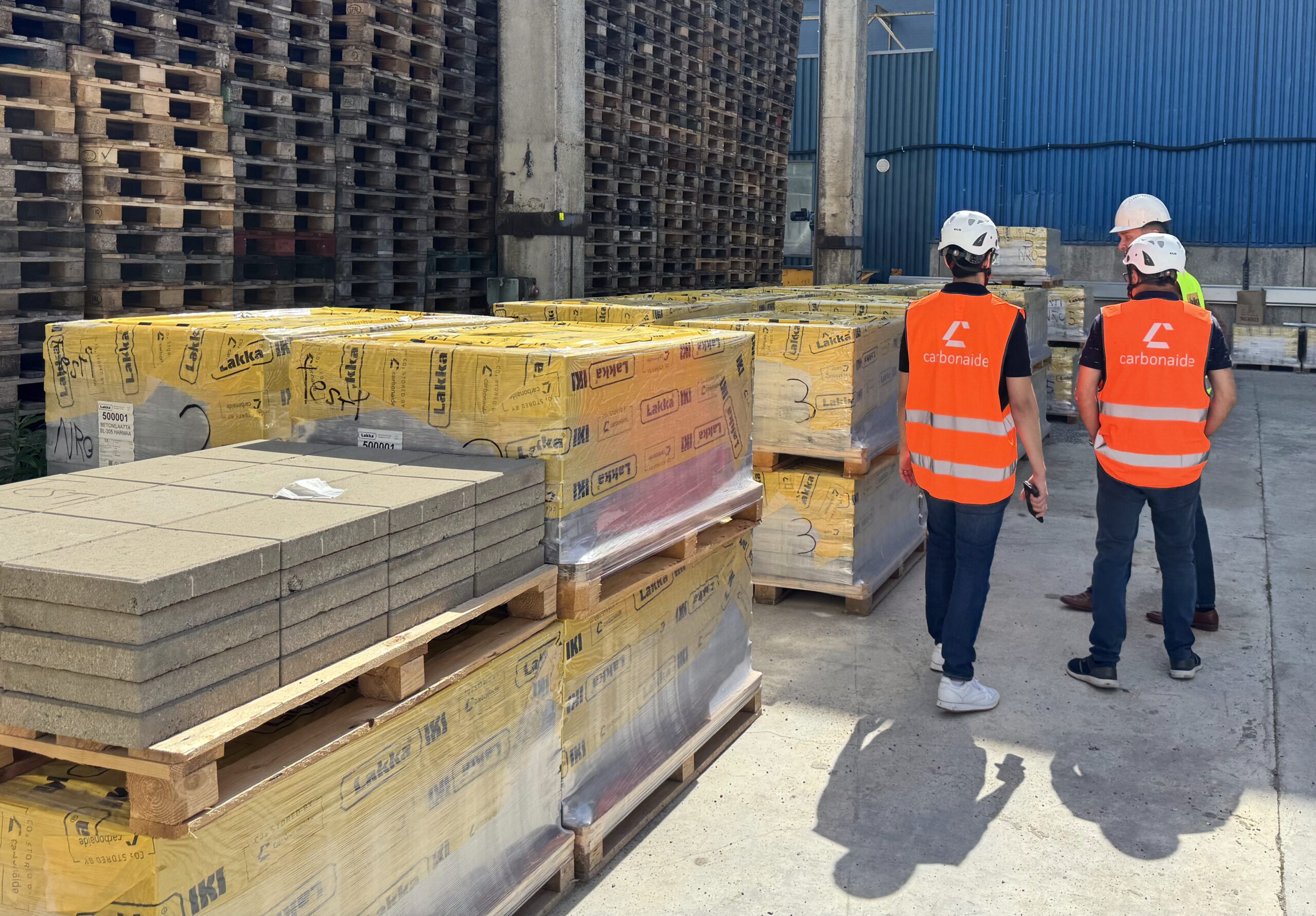
The Carbonaide technology is about CO2 treatment of concrete during the hardening phase of concrete in the so-called curing chambers at the concrete factory. Carbon dioxide curing, we call it. For that, we need carbon dioxide, and it must come from somewhere.
First question: What kind of CO2 are we using?
There are two sources of CO2: Fossil or biogenic.
In both cases, you catch the CO2 from somewhere, but with a fossil source you first cause emissions and try to reduce them by capturing part of the CO2. With biogenic sources, you remove existing CO2 from circulation.
The distinction between biogenic and fossil isn’t always easy, but if we simplify a complex story a bit, fossil CO2 is carbon dioxide released from the combustion of fossil fuels like coal, oil, and natural gas, while biogenic CO2 is carbon dioxide released from the combustion or decomposition of organic materials like plants and animal waste. The latter is considered part of the natural carbon cycle because the carbon was recently absorbed from the atmosphere and is likely to return to circulation sooner or later anyway, unlike the fossil fuels where carbon has been stored for millions of years and is now released by human action.
These definitions are man-made, sometimes bureaucratic, and often hard to understand. The answer lies sometimes in legislation, sometimes in deeper chemistry, but for most mortals it is enough to remember that there are two sources of CO2: biogenic and fossil.
In emission calculations, the source of CO2 matters, because it will define how we can later monetise the carbon storage.
Step 2: STORAGE
Regardless of the source of CO2, we can’t consider the carbon removed from circulation unless we can keep it out of the atmosphere, too. After capturing, the carbon dioxide must be securely stored somewhere.
Second question: Where do we store the CO2 and how long will it stay there?
With the help of renewable energy and green electricity, CO2 can be used as part of fuels and chemicals, where it can replace fossil materials and decrease the carbon footprint of products. This can be beneficial, but does not count as carbon storage, because the carbon will later return to the atmosphere.
Permanent carbon dioxide removal requires that the carbon stays out of the air forever, or at least centuries. In practice, the minimum requirement for permanent storage is 100 years. For example, storage in wood-based construction products is in the world of carbon storage considered long-lasting, but not permanent.
In the Carbonaide process, the carbon dioxide reacts with the cement and forms carbonates which are highly stable compounds and keep the carbon locked away, even if the concrete would be later crushed and recycled. That is permanent storage.

Step 3: UTILISATION
You can utilise CO2 in many beneficial ways, but unless you make sure the carbon stays away from the atmosphere for good, you only reduce emissions. For example the replacement of fuel and chemicals mentioned above can reduce the use of fossil materials, but the carbon dioxide is likely to return to circulation after a while.
This is often referred to as CCU, Carbon Capture and Utilisation. CO2 is used for reducing the emissions, but the reduction is only temporary, because the carbon is not permanently stored.
In contrast, the process of first capturing CO2 and then storing it permanently is called CCS, Carbon Capture and Storage. This is mostly used as a general term for all activities that catch some released carbon and isolate it from the atmosphere.
Third question: Can we utilise the CO2 for something useful while storing it?
A special feature of the Carbonaide carbon dioxide curing solution is that it enables CO2 utilisation benefits and carbon storage at the same time. This combination is called CCUS, Carbon Capture, Utilisation and Storage.
In our case in the concrete industry, we utilise carbon dioxide for example to reduce the cement content of concrete (this already reduces the carbon footprint of concrete quite a bit) and to enable faster curing. That’s the U part.
With Carbonaide’s carbon dioxide curing, however, the storage of carbon as carbonates in concrete is permanent, which means that we take care of the S at the same time as the U, and can introduce both utilisation and storage benefits in the same factory.
This is not always the standard practice elsewhere – in fact it is very rarely the case for most carbon utilisation and storage applications. CCU alone does not equal storage or removal, and CCS does not automatically indicate other utilisation benefits in addition to storage.
How we make low-carbon concrete economically viable
The utilization benefits in combination with the permanent carbon storage are important for the business case of low-carbon concrete. In a Carbonaide CO2 factory, we utilize AND store. That is how low-carbon concrete becomes economically viable.

About Carbonaide
Carbonaide makes carbon-negative concrete economically viable. With the Carbonaide CO₂ solution, concrete manufacturers can utilise carbon dioxide to improve their products and store carbon permanently.