
Concrete: one of the world’s most overlooked climate problems
Here’s a fact that may surprise you: Concrete generates more than three times the greenhouse emissions of all the world’s flights combined. It is the most used human-made material on Earth. Every year, billions of tons are produced, and only water is consumed by humans in greater volumes.
Concrete makes up roughly 8% of the world’s carbon dioxide emissions, compared to aviation at around 2.5%. We are encouraged to feel guilty about flying, but few of us worry about the new skatepark in the neighbourhood, the foundations of the building we are sitting in, or the concrete slabs outside our local shop.
This is exactly why concrete deserves our attention. Before going into what needs to be done about concrete’s footprint, we should take a closer look at what concrete actually is, and why we cannot stop using it.
What is concrete?
At its most basic, concrete consists of three ingredients:
- Aggregates: sand, gravel, or crushed stone that give the material its volume and strength.
- Cement: the binder (or binding agent) that holds everything together (like eggs in a cake mixture!)
- Water: activates the chemical reaction.
When these components are combined in the right proportions, a chemical process called hydration begins. The wet concrete ‘dough’ gradually transforms from a workable mass into solid, rock-like material. This hardening process, known as curing, continues for a long time. Handling and packing strength is reached after a few days, but the final strength may take months. Strength testing concrete products for quality assurance is typically performed after one, seven, and 28 days.
Concrete is not a single standardised material. Concrete recipes vary considerably depending on the application. Producers can adjust the mix to influence durability, strength, cracking behaviour and performance in different climates. Different combinations can also include chemical admixtures, or industrial by-products such as steel slag. Getting the recipe right matters enormously, which is why concrete undergoes continuous testing throughout the production and construction process.
Concrete and cement and why the distinction matters
Not sure what the difference between concrete and cement is? You are not alone. Concrete and cement are often mistakenly used interchangeably. To confuse matters further, when cement powder is mixed with water it looks a little like a wet concrete mixture – an off-white to grey paste. Understanding the difference, however, is essential from the environmental point of view.
Cement is an ingredient. Concrete is the finished product. Cement acts as the glue that binds aggregates together when mixed with water to produce concrete. Cement on its own has limited applications and is rarely used alone beyond filling small cracks. But in concrete, it enables the material’s strength and durability.
The distinction is crucial when looking at emissions. Cement is responsible for approximately 70-90% of concrete’s CO2 emissions. One could argue that it is cement that gives concrete its bad reputation.
There are two main reasons for this:
- Cement production requires extremely high kiln temperatures (usually powered by fossil fuels).
- Carbon dioxide is released from limestone during the chemical process.
If we want to reduce emissions from concrete and combat the ever-accelerating global construction aspirations, we need to focus on reducing the impact of cement.
There’s concrete, and then there’s concrete
Concrete production can be split roughly into two main methods: precast and ready-mix.
Precast (dry cast and wet cast)
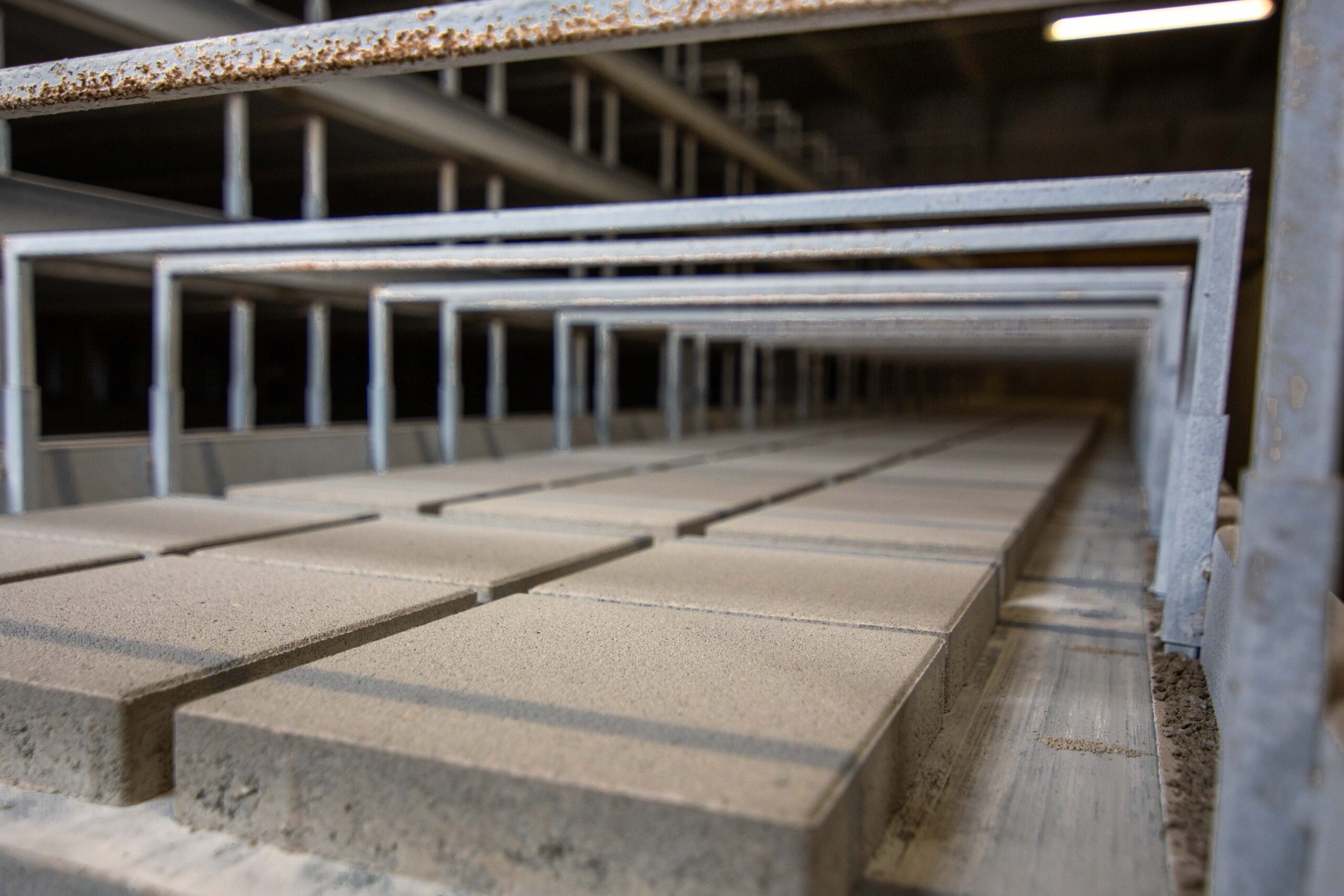
Manufactured in controlled factory conditions, precast concrete is everything from pavement slabs and kerbstones to larger structural components such as doors, walls and beams. These precast products are cast and cured before delivery and arrive ready for installation. This means the process is tightly controlled for quality, temperature, consistency and curing conditions in a way that concrete that is poured on-site cannot match. The result is therefore more predictable, and usually of high, uniform quality. There are two broad categories of precast concrete: dry cast and wet cast.
Dry cast precast concrete
Dry cast has very low water content and is of similar consistency to wet sand. The hydration process enabling the curing, however, is subject to water interacting with cement. Due to the low water content in dry cast, the concrete needs to be compressed for the hydration to take place. The dry mix is put into a mould, then compacted under significant pressure and vibration. This forces the particles together and allows the product to take its shape. The mould can then be removed within minutes and reused almost immediately. This makes dry cast efficient for high-volume production.
Typical dry cast products like slabs, blocks, pipes, and roof tiles are made in large quantities all over the world. Due to the low water to cement ratio, the products tend to be strong and practically impermeable. This makes them long-lasting and able to withstand challenging weather and traffic conditions.
Wet cast precast concrete
Wet cast has a much higher water content, producing a mixture that is fluid enough to pour into a mould. In the mould, the concrete is vibrated to remove air bubbles and ensure it fills every corner of the form. After this it is left to cure for a period of hours or days.
Because the mixture is fluid, it takes on the precise shape of the mould, just like a cake mixture does in a cake tin! This makes wet cast more versatile; it is used in elements such as panels, columns, staircases, and large structural elements. The downside compared to dry cast is the production speed. As the mixture takes longer to cure, the mould turnover is much slower. Therefore, wet cast is better suited to lower volume production of high value items.
Ready-mix concrete (RMC)
Transported to construction sites as a fresh mixture, ready-mix concrete is poured directly into moulds or formwork, then allowed to cure on-site. It is the sight of the revolving drum of a transit mixer truck that we’ve all seen on construction sites. Think of roads and bridges, or the foundations of a house.
The story begins at the batching plant where the precise combination of the concrete ingredients has been carefully mixed according to the requirements of the project. As soon as water and cement connect, the hydration process begins. This is where the transit mixer comes in – as the cement is loaded, the drum starts rotating to prevent the cement from stiffening prematurely. Once on-site, the concrete is poured into formwork, and the curing process can begin.
Why can’t we stop using concrete?
Given the environmental implications of concrete, it is fair to ask: Could we simply stop using it? The short answer is no. No other material today can match its combination of availability, performance, and cost efficiency at the scale required. Critical structures such as hospitals, bridges, tunnels, and flood defenses all rely on concrete.
The challenge therefore is not to replace concrete, but to transform how it interacts with the atmosphere.

About Carbonaide
Carbonaide makes carbon-negative concrete economically viable. With the Carbonaide CO₂ solution, concrete manufacturers can utilise carbon dioxide to improve their products and store carbon permanently.