

Lately, I have had a couple of discussion with potential customers about our carbon dioxide utilisation and storage solutions, where the other party has been struggling to estimate the return on the investment.
This is understandable. We are enabling a new way of manufacturing concrete, and the customers may not have enough data about the new technology to calculate the payback times. It turns out, too, that many companies proposing low-carbon technologies don’t have much data about their profitability (or are not willing to share it) so it is quite natural that the customers have learned to be cautious.
ROI calculations based on real-life data
However, we at Carbonaide have the data for the calculations. Lots of it, both from production in the factory and from the tests in our concrete lab.
Which is why I thought I would write a sequel to my previous blog post about ROI calculations of carbon dioxide curing of concrete. This is Part II of how to calculate the return on the investment in a Carbonaide CO2 system. This time with real-life numbers.
A production example from a dry-cast concrete factory: two kinds of emission reductions
Let’s consider a typical concrete facility producing, say, pavement stones, with a production capacity of 50 000 m3 of concrete products per year. If the average cement content is 250 kg/m3, then the cement consumption per year would be 12 500 tons.
With the Carbonaide carbon dioxide curing system in place, the factory would save 20% of the cement, which would be 2500 tons per year.
We would then get two kinds of emission reductions:
- If we assume that the CO2 footprint of a ton of cement is 750 kg, the reduced amount of cement in the product would automatically save 1875 tons of carbon dioxide per year, without any other changes in the recipe.
- At the same time, the Carbonaide system would store 2000 tons of CO2 into the products, which would give us the possibility to sell 2000 carbon credits.
If we then think that the cement price would be 180 euros/ton, the cement reduction will give the factory a yearly saving of 450 000 euros.
The credit sales would offer a new revenue stream for the factory. With a credit price of 300 euros, this would result in 600 000 euros of extra return on the investment per year.

Pay for the CO2 with the money you save on cement
On the cost side, you have the price of the CO2, which varies quite a bit between markets, but let’s use 220 euros as the CO2 price in our calculation. The CO2 for our example factory would then be 440 000 euros per year.
On many markets, CO2 prices are surprisingly close to cement prices, which means that you can pay for the CO2 with the savings you make by using less cement in the mix. Then all extra revenue from adding a price premium to the products or by selling carbon credits is return on the investment. This is the case in this calculation, too: cement saving of 450 000 euros, and a CO2 cost of 440 000, leaving the 600 000 euros of credit sales on the plus side.
Or get free CO2?
Alternatively, you can think about it like this: The CO2 does not cost anything, because you can get at least the same amount back for each ton when you sell the credits.
In fact, there are markets where gas providers are willing to deliver CO2 free to the factory, if they can keep the credits. This would make the model very simple from the manufacturer point of view. No management of credits, and you would still get all the savings and emission reductions of using less cement.
The operations costs of carbon dioxide curing
The return from the credit sales is not pure profit, though. The system requires electricity and water, and there are a number of smaller operational cost items. These also vary a lot from market to market, and location to location, but to keep the numbers nice and round, we can say this would be 50 000 euros per year.
Finally, there would be the license cost for the Carbonaide Service Platform that gives us all the measurements and certifications needed for CO2 management and emission savings. This is priced based on the CO2 volume that goes through the system: the platform cost in this case would be 100 000 a year.
Investments in CO2 management hardware and curing chamber upgrades
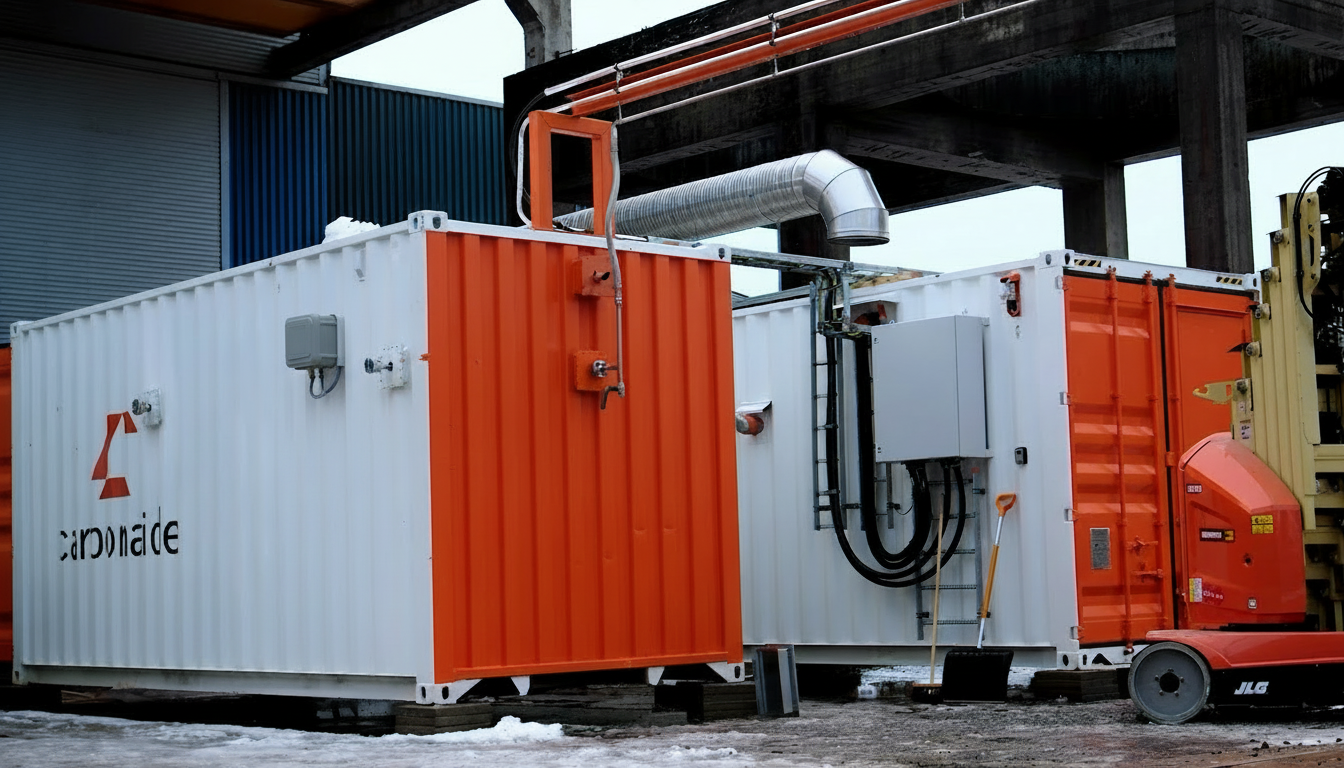
Obviously, there is a start CAPEX investment you need to make for the equipment and upgrades of the curing chamber to get the system going. This consists of two main parts: 1) the Carbonaide system hardware, typically delivered with a gas tank and an evaporator, and 2) the building work required to make the chamber area gas-tight for the CO2 treatment of products.
We can only give an exact amount for this part after evaluating the facilities and initial building plans, but so far we have typically ended with an investment of appoximatey 1,5 million euros, covering all hardware and installation work.
Money back in four years!
With the above example calculation, the yearly return would total 460 000, and the factory would get the invested money back in under four years. Not bad, considering the lifetime of the equipment might easily be 20 years.
For simplicity, I have kept all prices static here. That is obviously not the case going forward. It is likely that material prices will change quite a bit over the next five years. If you ask me, this will only make the business case better, because I believe the price of cement will go up and the price of carbon dioxide will sink (sorry, I can’t resists these word games).
It is clear that we need the carbon credit sales to make the equation work, though. There is not a stable market price for durable mineralisation credits yet, but we have seen a significant rise in interest towards them lately as buyers of credits are increasingly looking for quality and impact over quantity for their purchases. That said, the credit price of engineered credits is also likely to decrease over time, which means that in most cases, the carbon credits will keep on playing a major role in the financing for the storage.
If you want to hear more or sit down and run the calculations with your own numbers, let me know and we can book a meeting to discuss the business case in detail.
Also, if you disagree with the logic of calculations, I would like to hear about that, too!

About Carbonaide
Carbonaide makes carbon-negative concrete economically viable. With the Carbonaide CO₂ solution, concrete manufacturers can utilise carbon dioxide to improve their products and store carbon permanently.