
The business case for carbon mineralization in concrete rests on several interconnected factors: cement cost savings, faster curing cycles, improved product strength, and revenue from carbon credits. Together, these create a return on investment that goes beyond environmental compliance. The strength of the case depends on production volume, cement prices, available CO₂ sources, and how a producer accounts for carbon in their reporting. The sections below address each of the main questions concrete manufacturers ask when evaluating CO₂ curing as a commercial decision.
How much can carbon mineralization reduce concrete production costs?
Carbon mineralization in concrete can reduce production costs primarily by lowering cement consumption. Because cement is one of the most expensive inputs in concrete manufacturing, even a modest reduction in the required amount translates directly into lower material costs per cubic meter produced. The reduced curing time adds a second layer of savings by increasing throughput without additional capital expenditure on curing infrastructure.
The Carbonaide CO₂ curing process works by accelerating early-age strength development through two mechanisms: the formation of ultrafine calcium carbonate particles that act as nucleation sites, and the dissolution effect of CO₂ on cement particles. Both mechanisms allow concrete to reach the required early strength with less cement in the mix design.
For precast producers, faster curing is particularly valuable. Curing chamber turnover is often a production bottleneck. When CO₂ curing shortens the time products need to spend in chambers before demolding, the same physical infrastructure can produce more units per shift. This capacity gain has a real monetary value that compounds over time, especially for high-volume producers.
The actual cost reduction varies by product type, cement price in the local market, and the specific mix design used. Producers working with supplementary cementitious materials (SCMs) such as slag alongside CO₂ curing can push cement replacement further, amplifying the savings. There is no single universal figure, but the direction of the effect is consistent: CO₂ curing reduces the cost of producing concrete that meets standard strength requirements.
What role do carbon credits play in the business case?
Carbon credits provide an additional revenue stream that strengthens the business case for CO₂ curing beyond the direct production savings. When CO₂ is mineralized permanently into concrete, it qualifies as durable carbon dioxide removal (CDR), which can be certified and sold to companies seeking to offset their own emissions through voluntary carbon markets.
This matters because the mineralization process converts CO₂ into stable carbonate minerals within the concrete structure. These carbonates do not release back into the atmosphere, even if the concrete is later demolished and recycled. That permanence is what distinguishes mineralized carbon from other offset types and makes it eligible for high-integrity CDR certification.
For concrete producers, the carbon credit revenue works as follows: the Carbonaide Service Platform measures and documents the exact amount of CO₂ mineralized during each production cycle. This data supports independent verification and certification under recognized standards. The certified credits can then be sold to third-party buyers, generating income that partially or fully offsets the cost of the CO₂ curing system investment.
The commercial value of these credits depends on market conditions in voluntary carbon markets, which fluctuate. However, durable CDR credits generally command a premium over lower-permanence offset types because buyers increasingly recognize the difference between temporary carbon storage and permanent mineralization. For concrete producers, this means the credit revenue is not speculative in the same way as other offset categories: the underlying permanence is verifiable, and the certification pathway is established.
How does concrete strength improvement affect commercial value?
Strength improvement from CO₂ curing affects commercial value in two ways: it enables cement reduction without sacrificing product performance, and it can open access to product specifications that require higher mechanical properties. Both outcomes have direct financial implications for precast producers.
The densification of concrete microstructure during carbonation occurs through several mechanisms. Carbon dioxide replaces hydroxides with carbonates, which occupy greater molar volume and make the structure denser. Free silica released during this process reacts with remaining cement hydration products in the days and weeks after curing, providing additional strength gain compared to traditionally cured concrete of the same mix design.
From a commercial standpoint, the practical implication is that producers can reformulate their mix designs to use less cement while still meeting or exceeding the strength requirements of their product range. This is not a marginal gain: in some product categories, particularly lightweight precast elements, the strength improvement from CO₂ curing allows substantial cement replacement with less reactive materials.
It is worth being precise about what strength improvement means here. The goal is not to claim that CO₂-cured concrete is universally stronger than traditional concrete. Rather, CO₂ curing allows producers to reach equivalent or better performance with a leaner mix. That is where the commercial value lies: achieving the same specification at lower material cost, not producing a premium product that commands a higher price.
What is the carbon footprint difference between standard and CO₂-cured concrete?
Standard portland cement concrete carries a significant carbon footprint driven primarily by the calcination process in cement production. CO₂-cured concrete reduces this footprint through two mechanisms: less cement is needed in the mix, which cuts the emissions from raw materials, and CO₂ is permanently stored within the product, which generates negative emissions that offset the remaining footprint.
When CO₂ curing is combined with high-SCM or alternative binder mixes, the cumulative effect can shift the calculated carbon footprint of a concrete product from positive to negative. The Carbonaide method, for example, produces a calculated carbon footprint that is negative per cubic meter of concrete when the full system is optimized, compared to the substantially positive footprint of conventional concrete produced with standard portland cement.
The magnitude of the difference depends on several variables: the cement type and content in the original mix, the SCM used as a replacement, the amount of CO₂ mineralized per cubic meter, and the emission factor of the CO₂ source. Producers using industrial byproduct CO₂ and high-slag mixes achieve the largest footprint reductions. Producers making incremental changes to existing mix designs see more modest but still meaningful improvements.
For Environmental Product Declarations (EPDs) and procurement requirements that specify carbon footprint thresholds, this difference is commercially relevant. As more construction projects and public procurement frameworks require low-carbon concrete, the ability to document a verified, lower carbon footprint becomes a factor in winning contracts, not just a reporting exercise.
Which types of concrete producers benefit most from CO₂ curing?
Precast concrete producers with separate curing chambers benefit most from CO₂ curing because the process requires a controlled gas environment during the early hardening phase. Factories that already use steam curing or climate-controlled chambers can retrofit existing infrastructure to introduce CO₂ curing with relatively limited modifications.
Within the precast sector, producers of high-volume standard products see the strongest business case. Products such as wall elements, pavement slabs, and infrastructure components are produced in large quantities with consistent mix designs, which means the savings from cement reduction and faster curing accumulate rapidly. The return on the system investment scales with production volume.
Producers working with slag-rich or calcium-rich SCMs gain an additional advantage. CO₂ curing can activate otherwise passive materials, such as gamma dicalciumsilicate present in certain steel process slags, turning them into effective binders. This expands the range of cement substitutes available and can push the cement replacement ratio significantly higher than what conventional curing allows.
Producers in markets with high cement prices benefit more from the cost savings side of the equation. Producers in markets with active voluntary carbon markets or strong corporate demand for CDR credits benefit more from the carbon credit revenue side. The strongest business cases combine both: high cement costs and accessible carbon markets together make the financial return on CO₂ curing investment most compelling.
Ready-mix concrete producers face a different situation. Because CO₂ curing requires a controlled chamber environment during the early hardening phase, it does not apply directly to ready-mix production as currently practiced. The benefits described here are specific to precast and similar factory-based production processes.
What are the main barriers to adopting carbon mineralization at scale?
The main barriers to scaling carbon mineralization in concrete production are upfront capital cost, CO₂ supply chain logistics, mix design adaptation requirements, and the need for measurement and certification infrastructure. None of these are insurmountable, but each requires deliberate planning and investment.
The capital cost of a complete CO₂ curing system, including hardware, integration with existing curing chambers, and a software platform, represents a significant investment for most concrete producers. The return on this investment depends on production volume and the combined value of cement savings, throughput gains, and carbon credit revenue. For smaller producers with lower volumes, the payback period is longer, which makes the decision harder to justify without additional support such as grants or pre-purchase agreements for carbon credits.
CO₂ supply is a practical constraint that varies by location. Producers need access to a reliable source of CO₂ at a reasonable cost and with consistent delivery. In regions with established industrial gas infrastructure, this is manageable. In areas without nearby CO₂ sources, logistics add cost and complexity. The emission profile of the CO₂ source also matters for carbon accounting: using captured industrial CO₂ produces better environmental outcomes than using CO₂ derived from fossil sources.
Mix design adaptation requires technical expertise. Replacing cement with SCMs while maintaining product performance is not a simple substitution. It requires testing, adjustment of water-to-binder ratios, and validation against product standards. Producers without in-house concrete technology expertise may need external support during the transition period.
Finally, accessing carbon credit revenue requires measurement, verification, and certification processes that are new to most concrete producers. The administrative burden of participating in voluntary carbon markets is real, though software platforms designed for CO₂ flow management and carbon data reporting can reduce this significantly. As certification standards for concrete mineralization become more established, this barrier is likely to decrease over time.
How Carbonaide addresses the business case for CO₂ curing
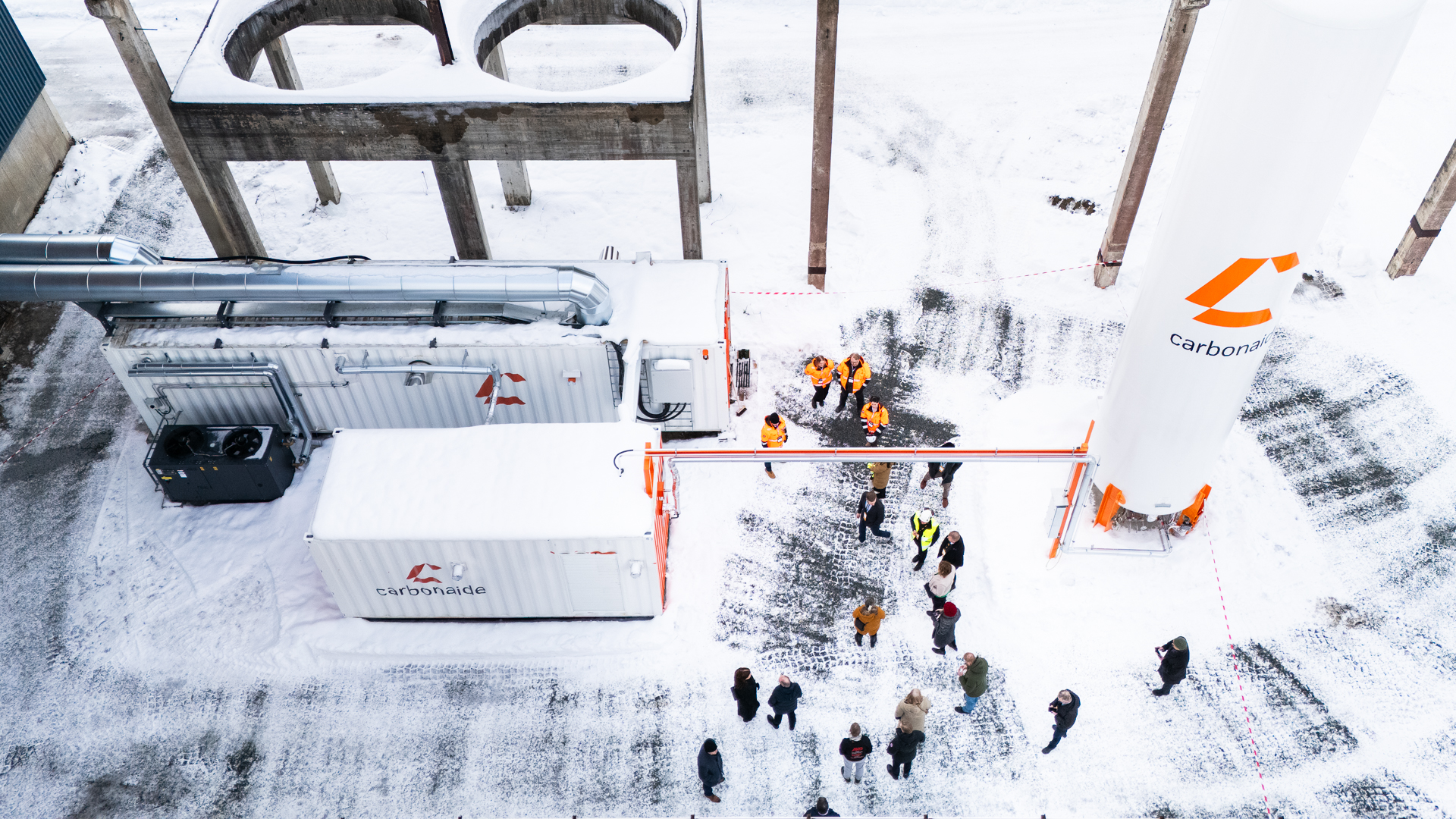
Carbonaide offers concrete manufacturers a complete system for implementing carbon dioxide curing in precast production, covering the technical, operational, and commercial dimensions of the investment.
- Carbonaide CO₂ Curing System: Hardware designed for integration with new facilities or retrofitting of existing curing chambers, with industry-leading precision for CO₂ management during the curing process.
- Carbonaide Service Platform: Cloud-based software that manages CO₂ flow, measures mineralized CO₂ per product batch, supports EPD reporting, and handles carbon credit verification and certification. The platform is certified under Isometric’s module for CO₂ storage via carbonation in the built environment.
- Carbonaide Care: Lifecycle support covering project management, setup, annual maintenance, and calibration to keep the system operating reliably over time.
- CO₂ sourcing and carbon credit management: For producers without an established CO₂ supply or carbon market relationships, Carbonaide can support both through its partner network.
The combination of cement savings, faster production cycles, and carbon credit revenue forms the return on investment calculation for each producer. Carbonaide provides tools to model this calculation based on actual production volumes and local cement prices, making the business case concrete rather than theoretical before a commitment is made.