
Public procurement requirements are reshaping how concrete manufacturers operate across Europe and beyond. Governments and public bodies are increasingly setting carbon footprint thresholds and environmental performance criteria as conditions for winning construction contracts, which means concrete producers who cannot demonstrate low-emission production face growing barriers to public sector work. The sections below address the most pressing questions concrete manufacturers are asking about procurement regulations, compliance, and practical paths forward.
What are public procurement requirements for construction materials?
Public procurement requirements for construction materials are rules and criteria that public bodies apply when purchasing materials or awarding construction contracts. These requirements increasingly go beyond price and technical performance to include environmental criteria, such as carbon footprint limits, Environmental Product Declarations (EPDs), and evidence of responsible sourcing. Any manufacturer supplying materials to publicly funded projects must meet these criteria to remain eligible.
Green public procurement, often abbreviated as GPP, is the framework through which governments embed environmental standards into purchasing decisions. At the European level, the European Commission has developed GPP criteria for a range of product categories, including construction works. Member states have adopted these criteria to varying degrees, with some countries embedding them directly into national procurement law.
For concrete manufacturers, the practical implication is that public clients can now specify requirements such as:
- A maximum carbon footprint per cubic metre of concrete, expressed in kilograms of CO₂ equivalent
- A valid EPD prepared according to recognised standards
- Use of supplementary cementitious materials (SCMs) or alternative binders to reduce Portland cement content
- Verified carbon storage or carbon removal claims where applicable
These requirements are not uniform across all markets. The specifics depend on the procuring country, the type of project, and whether the contracting authority has adopted mandatory or voluntary environmental criteria. However, the direction of travel across most European markets is clearly toward stricter and more detailed environmental conditions.
How are procurement rules changing for concrete specifically?
Procurement rules for concrete are moving from voluntary guidance toward mandatory thresholds, with carbon footprint performance becoming a measurable condition rather than a bonus criterion. Several European countries have already introduced or are piloting requirements that set upper limits on the embodied carbon of concrete elements used in public infrastructure and buildings.
The shift is driven by two parallel forces. First, national climate legislation is pushing public bodies to lead by example, using their purchasing power to accelerate decarbonisation in hard-to-abate sectors. Second, the wider regulatory environment around product environmental performance, including updates to construction product regulations and building codes, is creating pressure for manufacturers to quantify and disclose their emissions with greater precision.
In practice, this means concrete manufacturers are increasingly asked to provide EPDs that go beyond generic industry averages. Procurers want product-specific or facility-specific declarations that reflect the actual carbon footprint of what is being supplied. Manufacturers who rely on industry-average data in their EPDs may find that their declared carbon footprint is higher than competitors who have invested in measuring and reducing emissions at the production level.
There is also growing interest in procurement criteria that reward negative emissions, meaning concrete products that have stored more CO₂ than was emitted during their production. This creates an opportunity for producers who can demonstrate verified carbon storage through processes such as CO₂ mineralisation, where carbon dioxide is permanently bound into the concrete structure during curing.
What compliance challenges do concrete manufacturers face?
Concrete manufacturers face three main compliance challenges: accurately measuring and documenting their carbon footprint, reducing emissions to meet tightening thresholds, and managing the administrative burden of certification and reporting. Each of these challenges is substantial on its own, and they tend to arrive simultaneously as procurement requirements evolve.
Measurement and documentation
Producing a credible, product-specific EPD requires detailed data on raw material inputs, energy consumption, transport distances, and production processes. Many concrete manufacturers, particularly smaller precast producers, have not previously needed to collect this data at the level of granularity that procurement criteria now demand. Building the data infrastructure to support accurate carbon accounting is a significant undertaking.
Emissions reduction at production scale
Meeting carbon footprint thresholds is not simply a matter of paperwork. It requires actual changes to production, such as reducing Portland cement content, switching to SCMs or alternative binders, or adopting new curing processes. Each of these changes has implications for product quality, production speed, and cost, which means manufacturers must manage technical risk alongside regulatory compliance.
The administrative side of compliance is also demanding. Keeping EPDs current, responding to procurement questionnaires, managing third-party verification, and tracking regulatory changes across different markets all require dedicated resources. For manufacturers supplying multiple public sector clients across different countries, this complexity multiplies quickly.
How can concrete manufacturers reduce their carbon footprint to meet requirements?
Concrete manufacturers can reduce their carbon footprint primarily by decreasing Portland cement content, since cement production is the largest single source of emissions in concrete manufacturing. The main approaches are replacing cement with SCMs such as slag or fly ash, adopting alternative binders, optimising mix design, and using process technologies that enable cement reduction without compromising product performance.
Reducing cement content is the most direct lever available. SCMs such as ground granulated blast furnace slag can replace a portion of cement in the mix, lowering emissions while often maintaining or improving certain mechanical properties. The extent to which cement can be replaced depends on product requirements, curing conditions, and the specific SCM used.
Carbon dioxide curing is a process technology that opens additional pathways for cement reduction. During CO₂ curing, carbon dioxide is introduced into the curing chamber, where it reacts with calcium compounds in the concrete. This reaction accelerates strength development, which in turn reduces the need for excess cement to achieve early-age strength targets. The process also permanently mineralises CO₂ into the concrete structure, contributing to a lower calculated carbon footprint.
When CO₂ curing is combined with high SCM content or alternative binders, the cumulative effect on carbon footprint can be considerable. The Carbonaide CO₂ Curing System, for example, enables producers to reduce cement content while also storing CO₂ permanently in the product, addressing both the emission reduction and carbon storage dimensions of procurement criteria at the same time.
Other practical steps include:
- Optimising aggregate grading to reduce paste volume and cement demand
- Reviewing curing protocols to ensure cement is used efficiently
- Sourcing SCMs locally where possible to reduce transport-related emissions
- Investing in energy efficiency at the production facility
What role do carbon credits play in procurement compliance?
Carbon credits play a supporting role in procurement compliance rather than a primary one. Most public procurement requirements focus on the embodied carbon footprint of the concrete product itself, which means the emissions reductions must occur in the production process. However, verified carbon storage in the product, which can generate carbon removal credits, is increasingly recognised as a legitimate contribution to a product’s declared carbon footprint.
The distinction matters. Carbon offset credits, which represent emission reductions achieved elsewhere, are generally not accepted as a substitute for reducing the carbon footprint of the product being procured. Procurers want evidence that the concrete they are buying has a low or negative carbon footprint, not that the manufacturer has purchased offsets to compensate for high-emission production.
Carbon dioxide removal (CDR) credits derived from CO₂ mineralisation in concrete are different in character. When CO₂ is permanently bound into the concrete structure during curing, that storage is physically present in the product being delivered. If the storage is independently verified and certified, it can legitimately reduce the declared carbon footprint of the product in EPD calculations.
For manufacturers who store more CO₂ in their products than is emitted during production, the resulting negative carbon footprint can be a strong differentiator in procurement processes that use carbon footprint as an award criterion. CDR credits generated from this process can also be sold to third parties in voluntary carbon markets, creating an additional revenue stream that helps offset the cost of adopting new production technology.
The Carbonaide Service Platform supports this process by managing, measuring, and documenting CO₂ flow during curing, providing the data needed for carbon credit verification and EPD reporting. Independent certification of stored carbon gives procurement authorities confidence in the claims being made.
When should concrete manufacturers start preparing for stricter procurement rules?
Concrete manufacturers should begin preparing now. In 2026, several European markets already have active green public procurement criteria for construction materials, and the regulatory pipeline points clearly toward broader adoption and stricter thresholds in the coming years. Waiting until requirements become mandatory in a specific market means arriving late, with less time to adapt production, build data systems, and develop compliant product ranges.
The lead time for meaningful preparation is longer than many producers anticipate. Producing a credible, product-specific EPD requires months of data collection and third-party review. Modifying production processes, whether through SCM substitution, mix redesign, or investment in carbon dioxide curing technology, requires planning, testing, and often capital expenditure. Manufacturers who start this work now will be better positioned than those who wait for a regulatory deadline.
There are also commercial advantages to early preparation. Public sector clients in markets with active GPP programmes are already favouring suppliers who can demonstrate lower carbon footprints. Manufacturers who can provide verified EPDs with strong environmental performance are winning contracts that competitors with higher-emission products cannot access.
A practical preparation sequence might look like this:
- Audit current production to establish a baseline carbon footprint for key product lines
- Identify the largest emission reduction opportunities, typically cement content and curing process
- Develop product-specific EPDs that reflect actual production data rather than industry averages
- Evaluate process technologies, including carbon dioxide curing, that enable further reductions
- Build internal capability for ongoing carbon reporting and procurement documentation
- Monitor regulatory developments in target markets to anticipate threshold changes
The concrete manufacturers who treat procurement requirements as a production challenge rather than a paperwork exercise will be the ones best placed to compete as public sector standards continue to tighten.
How Carbonaide supports concrete manufacturers in meeting procurement requirements
Carbonaide offers a complete solution for precast concrete producers who need to reduce the carbon footprint of their products and document that reduction credibly for procurement purposes. The core components work together to address both the production and reporting dimensions of compliance:
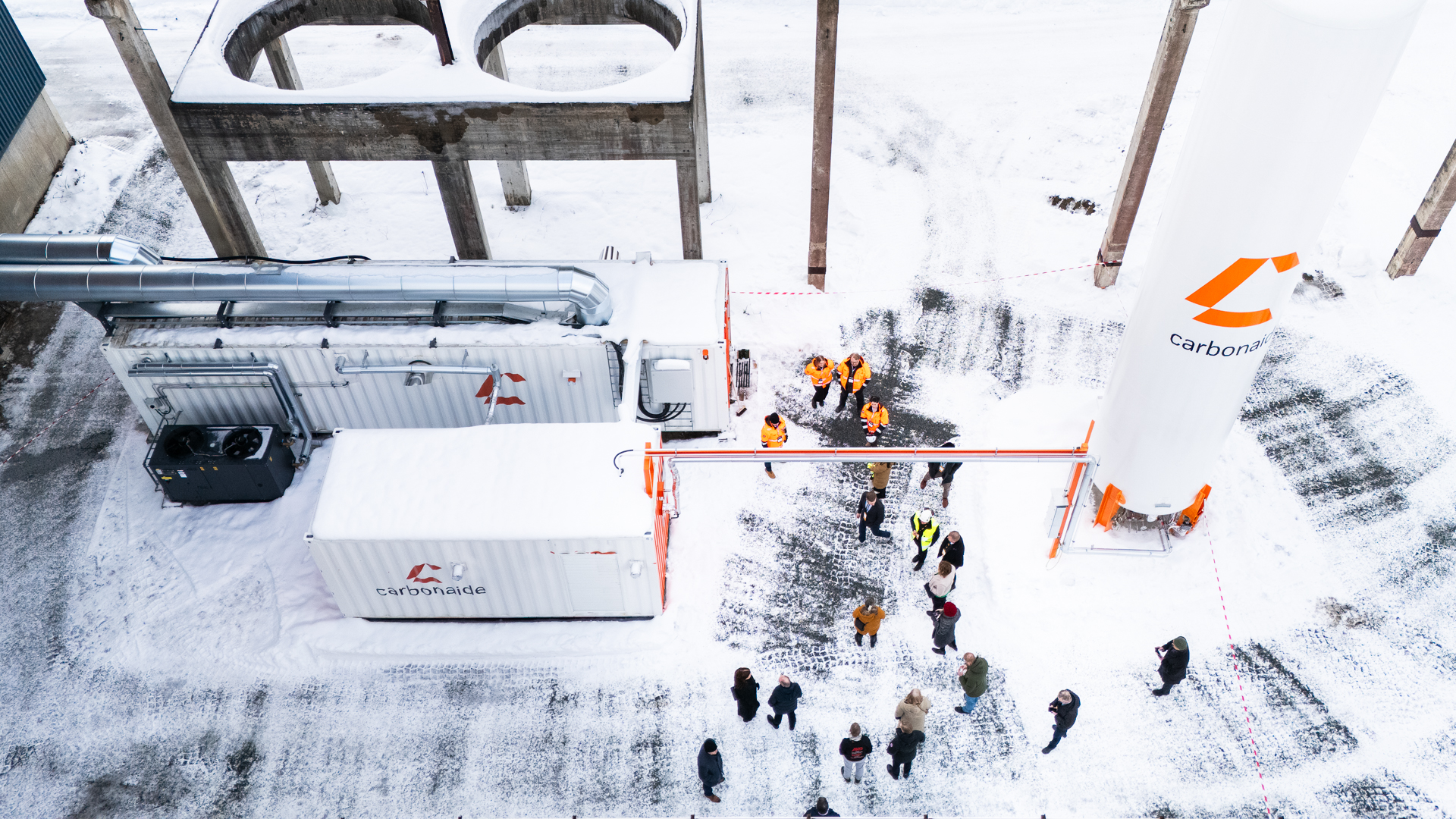
- Carbonaide CO₂ Curing System: Hardware that integrates with new or existing curing chambers, enabling CO₂ mineralisation at production scale. The system reduces the cement content needed in the mix and permanently stores CO₂ in the concrete product, lowering the calculated carbon footprint.
- Carbonaide Service Platform: Cloud-based software that manages CO₂ flow during curing, measures and records mineralised CO₂ in real time, and generates the data needed for EPD updates, carbon credit certification, and procurement reporting. The platform reduces administrative workload and centralises compliance documentation.
- Carbonaide Care: Lifecycle support covering installation, maintenance, and calibration, ensuring that the system performs reliably over time and that carbon storage measurements remain accurate.
For producers supplying public sector clients, the combination of verified emission reductions and independently certified carbon storage provides a strong and credible basis for meeting green public procurement criteria.