
Carbon removal and emission reduction are not the same thing, and treating them as interchangeable is one of the more common mistakes in climate discussions. Emission reduction means preventing CO₂ from entering the atmosphere in the first place. Carbon removal means taking CO₂ that is already in the atmosphere and storing it somewhere else, permanently. Both approaches address climate change, but they do different jobs, and the construction industry needs to understand that distinction clearly.
For concrete manufacturers and precast producers, this difference has direct implications: product carbon footprints, carbon credit eligibility, and how to position low-carbon concrete in an increasingly regulated market. The questions below unpack each layer of the distinction.
How does carbon removal actually work?
Carbon removal is the process of capturing CO₂ that exists in the atmosphere or in industrial gas streams and storing it in a stable, long-term form so it cannot re-enter the atmosphere. The key requirement is permanence: the carbon must remain stored for a meaningful period, typically defined as more than 1,000 years in the most rigorous certification frameworks.
There are several pathways to achieve this. Biological approaches include reforestation and soil carbon sequestration, where plants absorb CO₂ and store it in biomass or soil. Engineered approaches include direct air capture, biochar production, and CO₂ mineralisation in building materials. Each pathway differs in terms of permanence, cost, scalability, and verifiability.
Mineralisation is one of the most durable forms of carbon removal available. When CO₂ reacts with calcium ions in a material such as concrete, it converts into solid carbonate minerals. These carbonates are chemically stable and do not release CO₂ back into the atmosphere, even if the concrete is later demolished or recycled. This is what distinguishes mineralisation from biological storage methods, where carbon can be released if trees are cut down or soil is disturbed.
For concrete producers, the practical mechanism involves introducing CO₂ into the curing chamber during the early hardening phase of precast production. The gas reacts with the binder materials in the concrete mix, forming carbonates within the concrete structure itself. The result is permanent carbon storage embedded directly in the finished product.
What counts as emission reduction versus carbon removal?
Emission reduction refers to actions that lower the amount of CO₂ produced during a process. Carbon removal refers to actions that extract and store CO₂ that already exists, either in the atmosphere or in a captured industrial stream. The distinction matters because these two activities are accounted for differently in carbon reporting and carbon markets.
In concrete production, emission reduction includes using less Portland cement, replacing it with supplementary cementitious materials such as slag or fly ash, improving kiln efficiency, or switching to lower-emission energy sources. All of these reduce the CO₂ generated during manufacturing. They do not, however, remove CO₂ from the atmosphere.
Carbon removal in concrete production occurs when CO₂ is actively mineralised into the concrete structure during curing. If the CO₂ used in this process comes from a captured industrial source rather than being freshly emitted, the result is a net removal of carbon from the atmosphere. The concrete product then becomes a carbon sink rather than simply a lower-emission product.
A concrete product can achieve both simultaneously. Reducing cement content lowers the emissions associated with production. Mineralising captured CO₂ into that same product generates negative emissions. When both mechanisms are applied together, the calculated carbon footprint of the product can become negative, meaning more CO₂ is stored than was emitted during production.
Why can’t emission reduction alone solve the climate crisis?
Emission reduction alone cannot solve the climate crisis because it does not address the CO₂ already accumulated in the atmosphere over decades of industrial activity. Even if all new emissions stopped today, the existing concentration of atmospheric CO₂ would continue to drive warming for many years. Returning to safe atmospheric CO₂ levels requires actively removing carbon that is already there.
The construction industry illustrates this challenge clearly. Concrete is the most widely used construction material in the world, and its production has historically been a major source of CO₂ emissions. Even with significant reductions in cement content and improvements in production efficiency, the cumulative carbon debt from past production remains in the atmosphere.
There is also a practical ceiling to emission reduction in concrete manufacturing. Cement is a chemically necessary component of most concrete mixes, and its production releases CO₂ through both energy use and the calcination of limestone. Reducing cement content improves the emissions profile of concrete, but it cannot eliminate emissions entirely without fundamentally changing the chemistry of the material.
This is why carbon removal is increasingly recognised as a necessary complement to emission reduction, not a replacement for it. The construction industry has an opportunity that few other sectors share: the materials it produces at scale can serve as long-term carbon storage. Precast concrete products, manufactured in controlled factory settings with separate curing chambers, are particularly well suited to this role.
What’s the difference between carbon removal and carbon offsetting?
Carbon removal and carbon offsetting are related but distinct concepts. Carbon offsetting means compensating for emissions in one place by funding emission reductions or carbon storage somewhere else. Carbon removal specifically refers to the physical extraction and permanent storage of CO₂. Not all offsets involve genuine carbon removal, and this distinction is becoming more important as carbon markets mature.
Traditional carbon offsets have included activities such as funding wind farms, protecting forests, or distributing efficient cookstoves. These projects reduce emissions or prevent deforestation, but they do not necessarily remove CO₂ from the atmosphere. A forest protection project, for example, avoids future emissions but does not draw down existing atmospheric CO₂.
Carbon removal credits, by contrast, represent CO₂ that has been physically captured and stored. The most credible of these are classified as durable carbon dioxide removal credits, where the storage is verified to last more than 1,000 years. Mineralisation in concrete meets this standard because the carbonates formed during curing are geologically stable.
The carbon market is moving toward stricter definitions. Buyers of carbon credits, particularly large corporations with net-zero commitments, are increasingly distinguishing between avoidance credits (which prevent emissions) and removal credits (which draw down CO₂). Durable removal credits command higher prices and are subject to more rigorous verification requirements. For concrete producers, this means that CO₂ mineralisation generates a category of credit that is qualitatively different from most traditional offsets.
How is carbon removal measured and verified?
Carbon removal is measured by quantifying the amount of CO₂ that has been permanently stored and verifying that the storage meets defined standards for additionality, permanence, and accuracy. In concrete production, this means measuring the CO₂ absorbed during the curing process and confirming through independent verification that the mineralisation is genuine and durable.
The measurement process in CO₂ curing relies on gas flux monitoring: tracking the concentration and volume of CO₂ entering and leaving the curing chamber. The difference between input and output represents the CO₂ that has been mineralised into the concrete. Laboratory analysis of control samples provides additional confirmation of the mineralisation rate.
Verification is carried out by independent third-party certifiers who assess whether the measured carbon removal meets the requirements of a recognised certification standard. For mineralisation in concrete, this includes confirming that the CO₂ used is of industrial origin rather than freshly combusted, that the storage is permanent, and that the activity is additional, meaning it would not have occurred without the carbon removal incentive.
Additionality is a particularly important concept. It confirms that the carbon removal activity goes beyond what regulations or normal business practice would require. CO₂ mineralisation in concrete curing currently satisfies this criterion because it is not mandated by policy and would not be economically viable without carbon credit revenues in most markets.
The resulting certified credits can then be used by concrete producers to document the carbon footprint of their products or sold to third-party buyers in voluntary carbon markets. Accurate measurement and independent verification are what give these credits credibility in a market that has, in the past, been criticised for weak standards.
Which industries are best positioned to combine both approaches?
Industries that produce large volumes of materials in controlled, process-intensive environments are best positioned to combine emission reduction with carbon removal. The precast concrete sector stands out because it operates in factory settings with separate curing chambers, uses significant quantities of cement-based binders, and produces materials that can store carbon permanently within their structure.
Precast concrete production is particularly well suited because the curing process already takes place in enclosed chambers where conditions can be precisely controlled. Introducing CO₂ into this environment does not require a separate process or facility. The carbon removal activity integrates directly into the existing production workflow, which makes it economically viable at scale in a way that standalone carbon capture projects often are not.
Other industries with potential include steel production, where certain slag byproducts can absorb CO₂ through mineralisation, and cement manufacturing, where carbon capture at the kiln is being explored. However, the combination of emission reduction and durable carbon removal within a single, commercially available production process is currently most advanced in precast concrete manufacturing.
The availability of industrial CO₂ sources also matters. Precast concrete facilities located near industrial emitters, such as power plants, waste-to-energy facilities, or biogas producers, can access captured CO₂ at lower cost. This makes the economics of CO₂ curing more attractive and increases the net carbon removal achieved, since the CO₂ used is diverted from the atmosphere rather than freshly generated.
How Carbonaide supports both emission reduction and carbon removal
Carbonaide offers precast concrete producers a practical way to achieve both goals within their existing production process. The solution combines hardware, software, and lifecycle support to make CO₂ mineralisation commercially viable at factory scale.
- Emission reduction through cement savings: The CO₂ curing process accelerates strength development, which allows producers to reduce the cement content in their concrete mix. Less cement means lower production emissions without compromising product quality.
- Carbon removal through mineralisation: Captured CO₂ introduced during curing reacts with binder materials and converts into stable carbonate minerals within the concrete structure. This storage is permanent and verifiable.
- Measurement and certification: The Carbonaide Service Platform monitors CO₂ flow in real time, quantifies the amount mineralised per product batch, and supports the documentation needed for carbon credit certification under recognised standards.
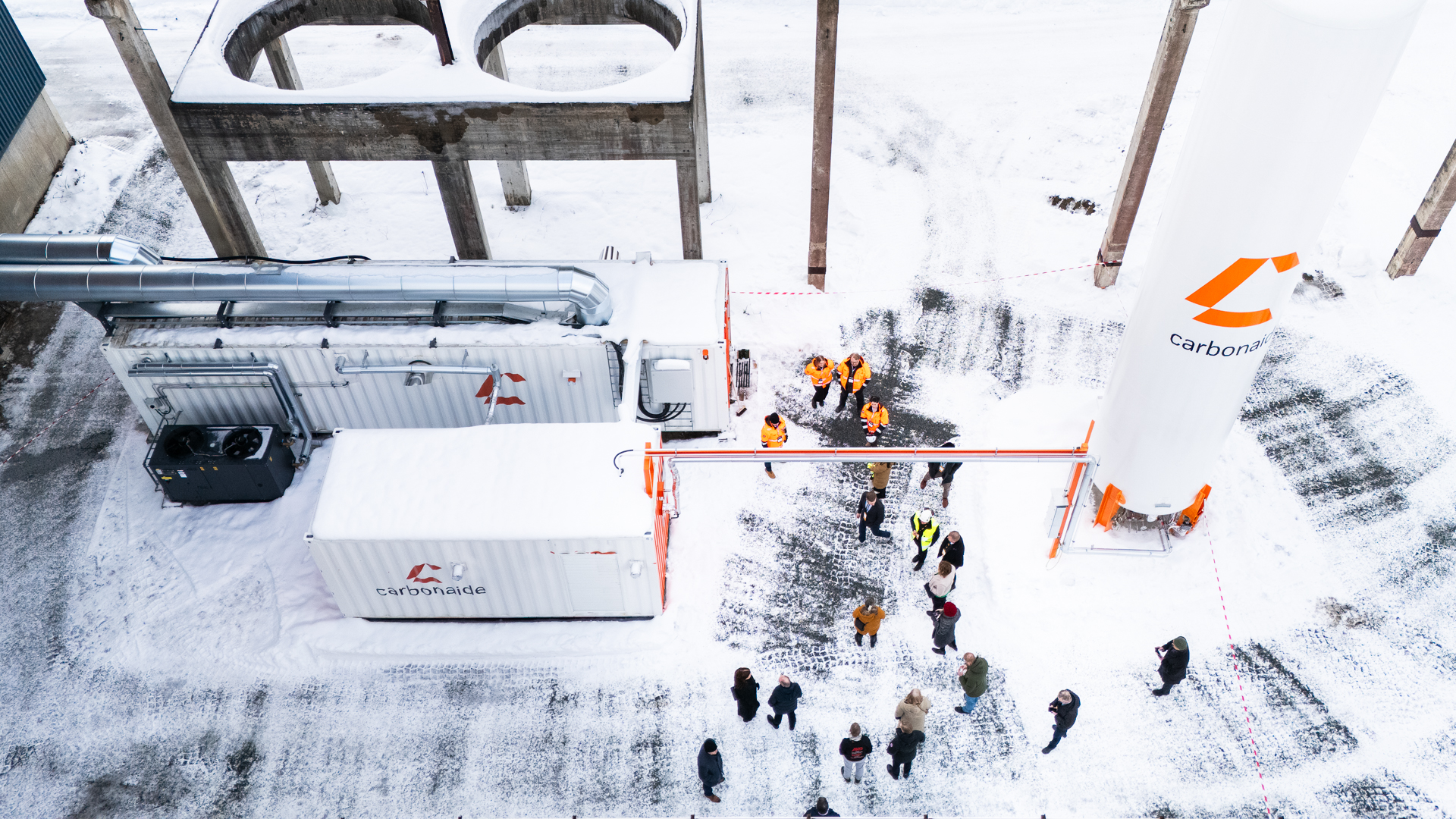
- Integration with existing facilities: The Carbonaide CO₂ Curing System can be retrofitted into existing curing chambers, which means producers do not need to build new infrastructure to get started.
- Support for alternative binders: When slag or other supplementary cementitious materials are used alongside CO₂ curing, the combined effect can bring the calculated carbon footprint of a concrete product into negative territory.
The combination of reduced cement use and permanent CO₂ mineralisation means that precast producers can address both sides of the carbon equation at once: producing less CO₂ during manufacturing and storing additional CO₂ within the finished product. That is the practical difference between a lower-emission product and a genuine carbon sink.