
Sustainability requirements are reshaping precast purchasing decisions across the construction industry. Buyers, specifiers, and procurement teams now routinely evaluate concrete products against carbon footprint thresholds, green building certification criteria, and embodied carbon benchmarks before placing orders. The questions below unpack the specific requirements driving these shifts and what they mean for precast manufacturers in 2026.
How are green building certifications shaping precast procurement?
Green building certification schemes such as LEED, BREEAM, and DGNB are directly influencing which precast products get specified and purchased. These frameworks award credits or points based on the environmental performance of building materials, which means the concrete products a manufacturer supplies can determine whether a construction project qualifies for a particular certification level. Procurement teams working on certified projects are therefore selecting precast suppliers based on documented environmental credentials, not price alone.
The practical effect is that precast producers without verified environmental data are increasingly excluded from tender shortlists. Certification schemes require evidence: environmental product declarations, carbon footprint calculations, and in some cases, third-party verification of emission reduction claims. Suppliers who can provide this documentation gain a clear advantage in competitive procurement processes.
The influence of certification schemes also flows upstream. Architects and project developers specify certification targets early in the design phase, which means the environmental requirements reach precast producers long before construction begins. Manufacturers who understand the point-scoring logic of major certification frameworks can align their product data accordingly, making it easier for project teams to hit their targets.
What carbon footprint thresholds are buyers setting for concrete products?
Buyers are increasingly setting explicit carbon footprint limits for concrete products, expressed in kilograms of CO₂ equivalent per cubic metre or per unit of product. These thresholds vary by project type, regional regulation, and client sustainability targets, but the direction is consistent: limits are tightening. Procurement specifications that once required only a carbon footprint declaration now include upper limits that products must fall below to qualify.
In markets where public procurement rules incorporate embodied carbon requirements, these thresholds carry legal weight. A precast product that exceeds the specified limit cannot be purchased regardless of its other merits. In private development, thresholds are often set by corporate sustainability commitments or investor requirements, which can be equally firm in practice.
The significance of these thresholds for precast manufacturers is that they create a direct link between production methods and market access. Conventional Portland cement concrete carries a carbon footprint that makes it difficult to meet the lower thresholds now appearing in specifications. Producers who reduce cement content, use supplementary cementitious materials (SCMs) such as slag or fly ash, or permanently store CO₂ during the curing process can achieve carbon footprints that fall within the required limits and remain competitive in these tenders.
Why are EPDs becoming a non-negotiable in precast tenders?
Environmental Product Declarations (EPDs) are becoming a standard requirement in precast concrete tenders because they provide a standardised, third-party verified account of a product’s environmental impact across its lifecycle. Without an EPD, a precast producer cannot demonstrate compliance with carbon footprint thresholds or contribute meaningful data to a project’s green building certification assessment. Tenders that once requested EPDs as a preference now list them as mandatory submission documents.
The reason EPDs have moved from optional to obligatory is the growing demand for comparability. Buyers need to evaluate competing products on a consistent basis, and self-reported or unverified carbon data does not allow that. EPDs produced under recognised standards give procurement teams a reliable basis for comparison, and they provide the documentation trail that auditors, certifiers, and regulators require.
For precast manufacturers, producing EPDs requires accurate lifecycle assessment data, which in turn requires clear measurement of inputs, outputs, and emissions across the production process. Manufacturers who invest in measurement infrastructure and data management systems are better positioned to produce credible EPDs efficiently. Those who cannot provide verified product-level data face a growing barrier to entry in specification-led markets.
There is also a competitive dimension beyond compliance. A well-documented EPD that shows a genuinely low carbon footprint is a sales tool as well as a compliance document. Precast producers who can demonstrate measurable emission reductions through their production methods can use their EPDs to differentiate their products in markets where multiple suppliers meet the minimum threshold.
How does embodied carbon regulation affect precast manufacturers?
Embodied carbon regulation places direct obligations on construction projects to measure, report, and in some cases, limit the carbon embedded in building materials during their manufacture. For precast manufacturers, this means that the carbon footprint of their products is no longer just a marketing consideration: it is a factor that determines whether their products can be used on regulated projects at all.
Regulatory approaches differ by country and region. Some markets have introduced mandatory whole-life carbon assessments for new buildings, which require project teams to account for the embodied carbon of every major material, including structural concrete. Others have set maximum allowable global warming potential values for specific product categories. In both cases, the downstream effect on precast procurement is the same: buyers need products with documented, low carbon footprints.
The regulatory pressure also affects manufacturers indirectly through the supply chains of large construction companies. Even where regulation applies at the project level rather than the product level, main contractors pass the compliance burden to their suppliers through procurement requirements. Precast producers supplying regulated projects must provide data that enables the main contractor to meet their reporting obligations.
Manufacturers who treat embodied carbon regulation as a compliance burden rather than a market signal risk falling behind. Those who build the production capability and data infrastructure to supply genuinely low-carbon precast products are positioned to serve the growing share of the market where regulation is already active, and to be ready as requirements extend to new regions and project types.
What role does CO₂ curing technology play in meeting these requirements?
CO₂ curing technology helps precast manufacturers meet sustainability procurement requirements by reducing the carbon footprint of concrete products through two simultaneous mechanisms: reducing the amount of cement needed in the mix and permanently storing CO₂ within the concrete structure through mineralisation. Both effects reduce the product’s net carbon footprint, which is directly relevant to carbon thresholds, EPD values, and embodied carbon compliance.
The cement reduction effect works because CO₂ introduced during the curing phase accelerates strength development and densifies the concrete microstructure. This allows manufacturers to reduce Portland cement content without compromising product performance. Since cement production is the primary source of CO₂ emissions in concrete manufacturing, reducing cement content produces a direct reduction in the product’s carbon footprint.
The CO₂ mineralisation effect goes further. When CO₂ is mineralised into the concrete during curing, it is converted into stable carbonate minerals that remain permanently bound within the product. This stored carbon counts as a negative emission in lifecycle assessment calculations, reducing the product’s reported carbon footprint below what cement savings alone would achieve. When CO₂ curing is combined with SCMs such as steel slag as partial or full cement replacements, the resulting carbon footprint can reach net-negative values, which positions the product well within even the most demanding procurement thresholds.
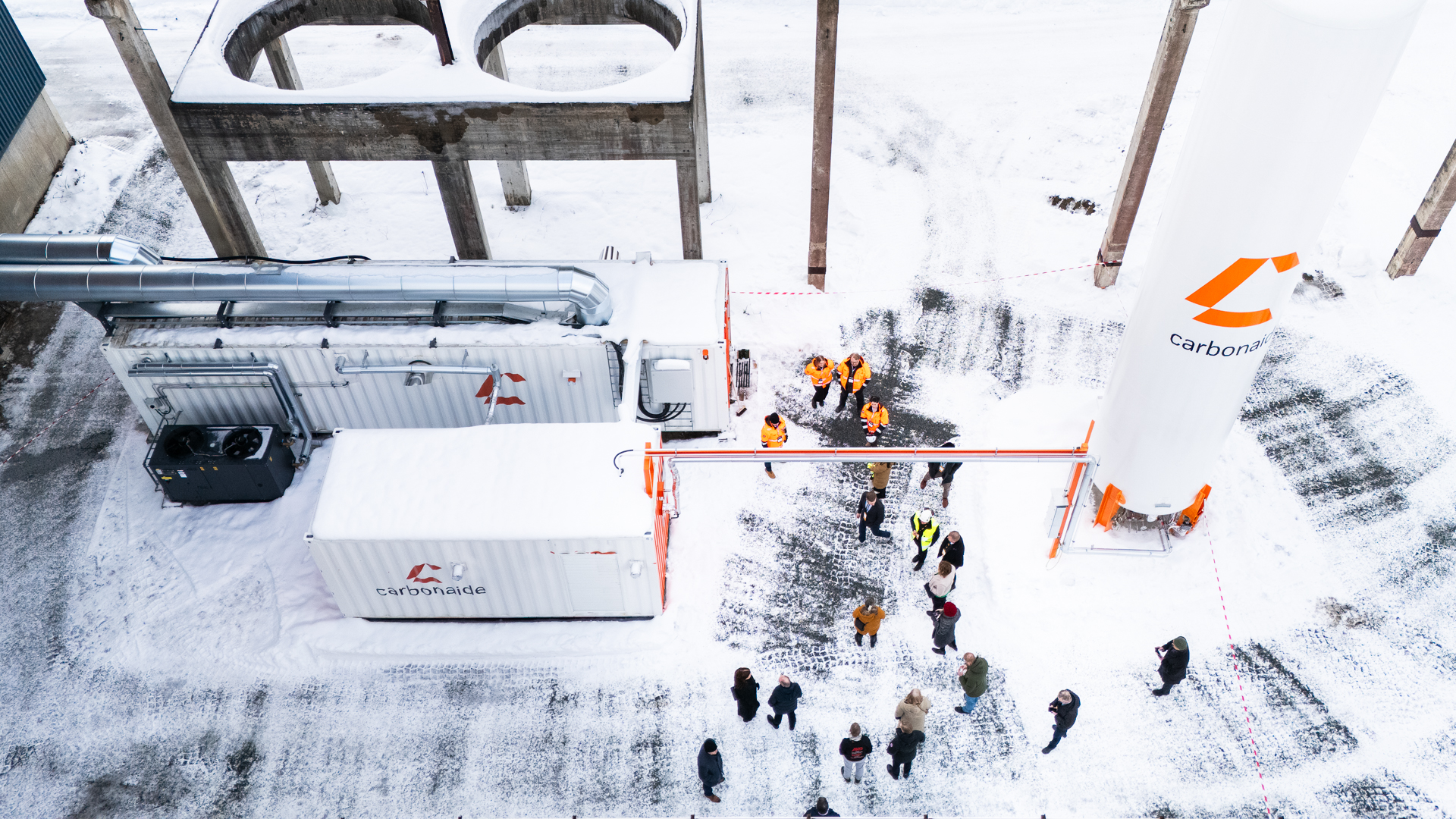
The Carbonaide CO₂ Curing System is designed to deliver these outcomes at production scale for precast concrete manufacturers. The system integrates with existing or new curing chambers and is managed through the Carbonaide Service Platform, which provides the real-time measurement, data management, and carbon storage documentation that EPD production and carbon credit certification require. For procurement purposes, this means manufacturers using the system can generate verified, product-level carbon data that supports EPD updates and compliance reporting.
- Cement content reduction: CO₂ curing enables lower cement use without reducing product strength, directly lowering the carbon footprint per cubic metre.
- Permanent CO₂ mineralisation: CO₂ stored as carbonates within the concrete counts as a negative emission in lifecycle calculations, improving EPD values.
- SCM compatibility: The process works with a range of alternative binders and SCMs, enabling carbon footprints that can reach net-negative levels depending on the material mix.
- Verified data for EPDs: The Carbonaide Service Platform measures and certifies the amount of CO₂ mineralised per product batch, providing the documented evidence that EPDs and procurement requirements demand.
- Carbon credit generation: Permanently stored CO₂ can be certified as durable carbon dioxide removal credits, creating an additional revenue stream alongside the procurement advantages.
As sustainability requirements in precast procurement continue to tighten, the ability to supply products with a documented, low or net-negative carbon footprint becomes a practical market requirement. CO₂ curing technology gives precast manufacturers a production-scale path to meet that requirement without restructuring their entire operation.