
The technologies that enable permanent carbon storage in construction materials work through a process called CO₂ mineralisation, where carbon dioxide reacts with calcium compounds in concrete to form stable carbonate minerals. These carbonates become part of the concrete structure itself, locking CO₂ away permanently rather than releasing it back into the atmosphere. The sections below walk through how this works in practice, which product types benefit most, and how the stored carbon is measured and verified.
How does CO₂ mineralization permanently store carbon in concrete?
CO₂ mineralisation permanently stores carbon in concrete by converting gaseous carbon dioxide into solid carbonate minerals within the concrete matrix. During the curing process, CO₂ reacts with calcium ions from cement and supplementary cementitious materials (SCMs) to form calcium carbonate. This reaction is chemically stable and does not reverse under normal conditions, making the storage genuinely permanent.
The chemistry behind this is straightforward. When CO₂ is introduced into a curing chamber, it dissolves into the pore water of fresh concrete and reacts with calcium-bearing phases from the binder. The result is the formation of calcium carbonate minerals, which are denser and more stable than the hydration products they partly replace. This densification also improves the mechanical properties of the concrete, meaning the mineralisation process delivers structural benefits alongside carbon storage.
What makes this form of carbon storage particularly reliable is its irreversibility. Carbonate minerals are thermodynamically stable and do not release CO₂ back into the atmosphere, even when the concrete is demolished or mechanically crushed at the end of a building’s life. The carbon remains mineralised in the recycled material, which means the storage is not tied to the lifespan of any particular structure.
What are the main technologies used for carbon storage in construction materials?
The main technology used for permanent carbon storage in construction materials is CO₂ curing, also referred to as carbon dioxide curing or carbonation curing. In this process, precast concrete products are placed in sealed curing chambers where CO₂ is introduced under controlled conditions, triggering mineralisation within the concrete. Other approaches to carbon storage in the built environment exist, but CO₂ curing of precast concrete currently offers the most scalable and commercially viable path.
CO₂ curing systems for precast concrete
CO₂ curing systems introduce gaseous CO₂ into sealed curing chambers at atmospheric pressure. The concrete absorbs the gas during its early hardening phase, and the mineralisation reaction proceeds within hours. This approach integrates with standard precast production workflows and can be retrofitted into existing factory curing chambers, which makes it accessible to producers without requiring entirely new facilities.
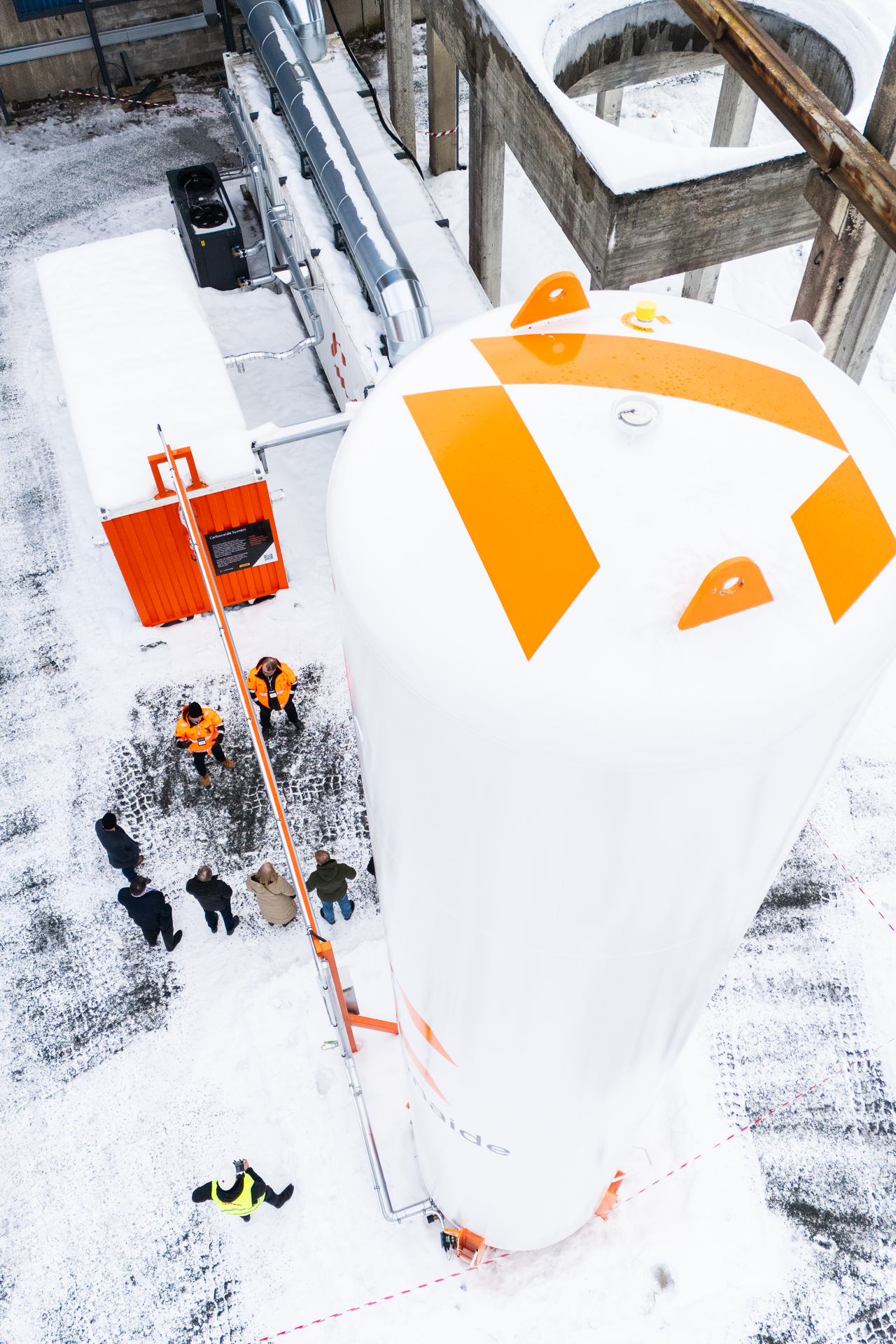
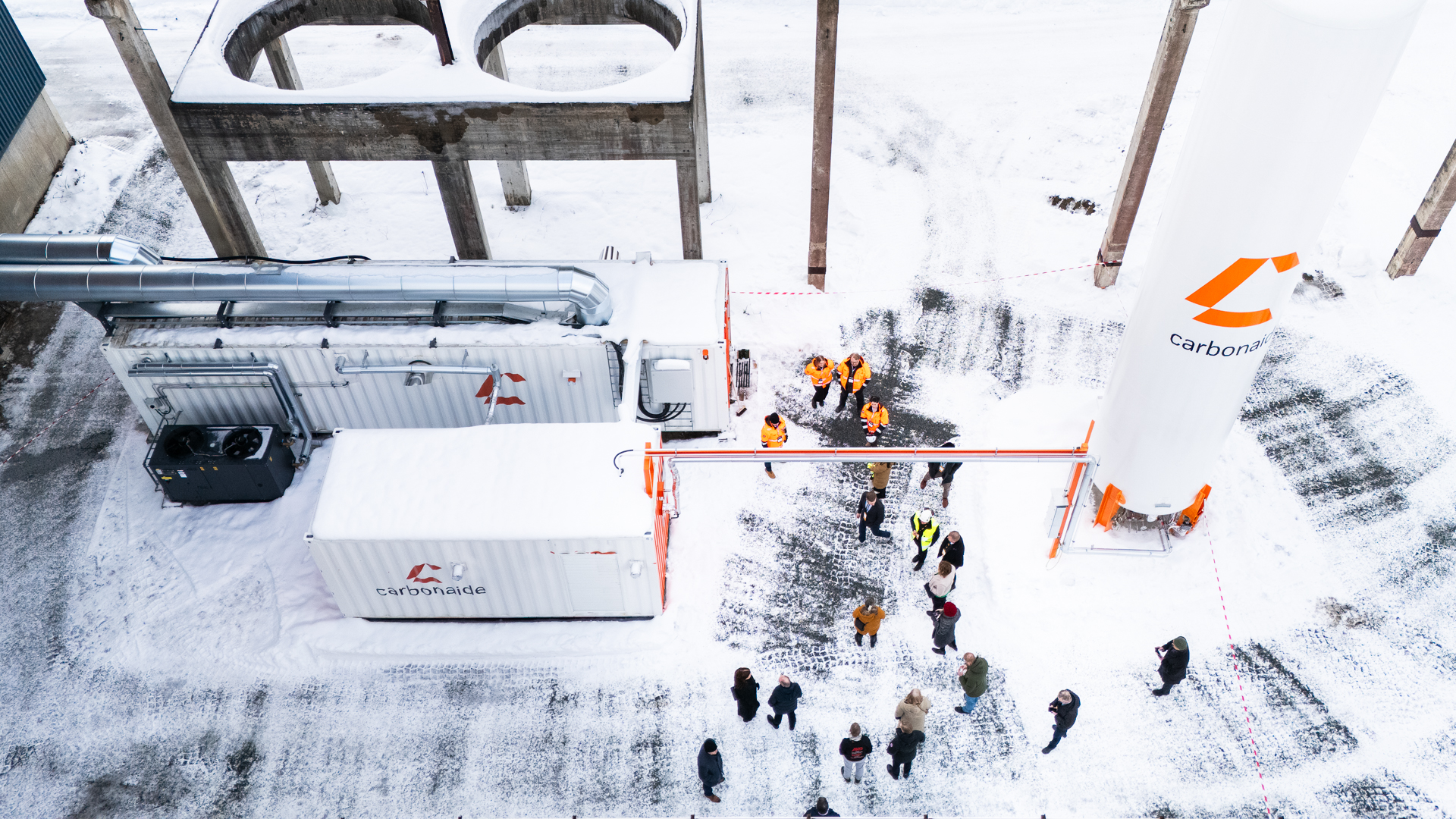
The Carbonaide CO₂ Curing System is an example of a production-scale implementation of this technology, designed specifically for precast concrete and small concrete product manufacturers. It manages CO₂ flow with precision, enabling producers to control how much CO₂ is mineralised per batch and to balance the process between cement reduction, faster curing, and carbon storage depending on production requirements.
Alternative binder approaches
When CO₂ curing is combined with alternative binders such as steel slag, the potential for carbon storage increases significantly. Certain slags contain gamma-dicalciumsilicate, a phase that is non-reactive under normal curing conditions but becomes an effective binder when CO₂ is present. This opens the door to concrete mixes where cement content is drastically reduced or, in some cases, replaced almost entirely, which pushes the carbon footprint of the product toward net-negative territory.
How does CO₂ curing differ from traditional concrete curing methods?
Traditional concrete curing relies on moisture retention and temperature control to drive cement hydration, a process that takes days to reach target strength. CO₂ curing introduces gaseous carbon dioxide into the curing environment, which accelerates strength development through two distinct mechanisms while simultaneously mineralising CO₂ into the concrete structure. The key difference is that CO₂ curing adds a chemical reaction that does not occur in traditional curing.
In the first hours of curing, CO₂ reacts with calcium to form ultrafine calcium carbonate particles. These act as nucleation sites that speed up the hydration of cement, similar in effect to a seeding accelerator. Later, the acidic nature of dissolved CO₂ increases the dissolution rate of binder phases, further driving strength development. The combined effect is a measurable reduction in curing time compared to standard methods.
Traditional curing produces no carbon storage benefit and requires higher cement content to achieve early-age strength targets, particularly for lightweight or low-density products. CO₂ curing changes this relationship: because the process accelerates strength development and densifies the concrete microstructure, producers can reduce cement content without compromising performance. The result is a production process that is faster, uses less cement, and permanently stores CO₂ within the product.
Can construction materials actually become carbon-negative?
Yes, construction materials can achieve a net-negative carbon footprint when CO₂ curing is combined with the right binder materials. This happens when the amount of CO₂ mineralised into the concrete exceeds the emissions generated during production, including those from raw material extraction, binder production, and manufacturing energy. Reaching this outcome requires both a significant reduction in cement content and a meaningful volume of CO₂ stored per cubic metre of product.
The pathway to carbon-negative concrete typically involves replacing a large proportion of Portland cement with industrial byproducts such as steel slag or other SCMs. Portland cement production is the primary source of emissions in conventional concrete manufacturing. When CO₂ curing activates otherwise passive materials like slag, it becomes possible to use these byproducts as effective binders, reducing the share of high-emission cement in the mix.
It is important to distinguish between reducing emissions and achieving genuinely negative emissions. Reducing cement content lowers the carbon footprint of the product. Mineralising CO₂ that would otherwise remain in the atmosphere adds a removal component. When both effects are combined and the removal exceeds the remaining production emissions, the product becomes a carbon sink. This is not a theoretical outcome: Carbonaide’s production data from its first operational facility demonstrate that certain product types can achieve a negative calculated carbon footprint per cubic metre of concrete.
How is permanently stored carbon in concrete verified and measured?
Permanently stored carbon in concrete is measured through gas flux monitoring during the curing process, where the difference between CO₂ introduced into the curing chamber and CO₂ remaining after curing is used to calculate how much has been mineralised. This measurement is supported by laboratory analysis of control samples, which confirm the accuracy of the process data. Independent third-party certification then verifies the results for use in carbon reporting and carbon credit markets.
Accurate quantification depends on controlling the curing environment precisely. The CO₂ concentration, temperature, humidity, and exposure time all affect how much carbon is mineralised. A software platform that monitors and manages these variables in real time is therefore not just a convenience but a requirement for credible measurement. The Carbonaide Service Platform performs this function, tracking CO₂ flow at the chamber and product batch level and generating the data needed for carbon credit certification.
Certification of durable carbon dioxide removal credits from concrete mineralisation follows established protocols. The project is certified under Isometric’s module for CO₂ storage via carbonation in the built environment, which requires additionality, permanence, and accurate quantification. Additionality is straightforward to demonstrate because CO₂ mineralisation is not required by regulation. Permanence is supported by the thermodynamic stability of carbonate minerals, which do not release CO₂ even when concrete is demolished and recycled. These characteristics make mineralised CO₂ one of the more robust forms of carbon removal available to the construction sector.
Which construction product types are best suited for CO₂ storage technology?
Precast concrete elements and small concrete products manufactured in separate curing chambers are best suited for CO₂ storage technology. These product types allow producers to control the curing environment precisely, which is a requirement for effective CO₂ mineralisation. Products such as wall elements, pavement slabs, kerbs, pipes, and other infrastructure components produced in precast facilities are the primary candidates for this technology.
The suitability of a product type depends on several practical factors. The product must be cured in a chamber or enclosed space where CO₂ concentration can be maintained. Ready-mix concrete placed on a construction site is not compatible with CO₂ curing in its current form because there is no controlled curing environment. Precast production, by contrast, already uses curing chambers as a standard part of the manufacturing process, which means CO₂ curing can be integrated without fundamentally changing the production workflow.
Lightweight products with lower initial cement content tend to benefit particularly from CO₂ curing because the process compensates for the slower early-age strength development that comes with reduced cement use. Products where a high proportion of cement can be replaced with SCMs or alternative binders also offer greater potential for carbon negativity. The specific product mix, binder composition, and production volume all influence how much CO₂ can be stored and what carbon footprint reduction is achievable, which is why producers benefit from assessing their own production parameters before committing to a system.